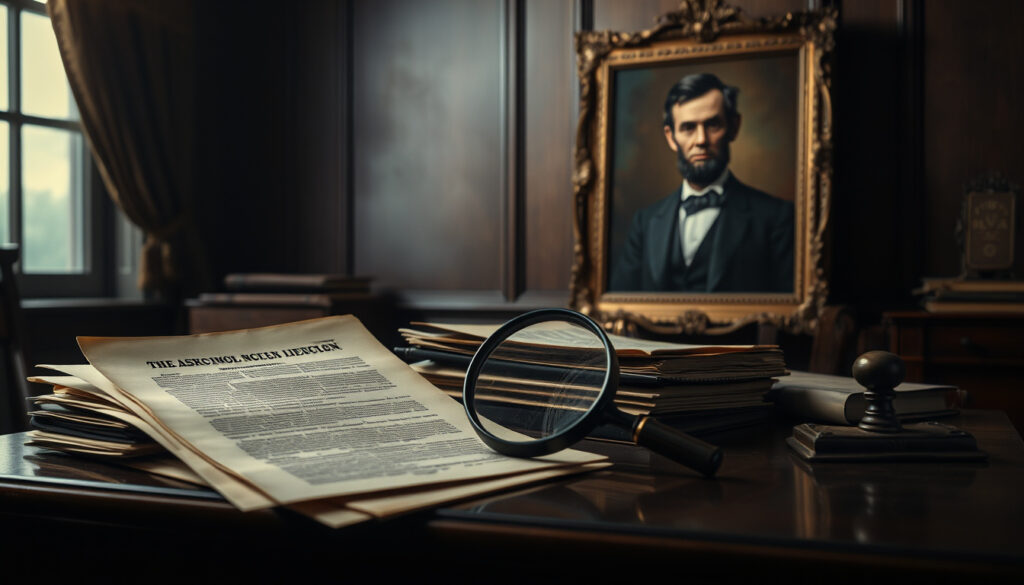
Abraham Lincoln: Facts, Assassination & Myths Debunked
Abraham Lincoln remains one of the most studied and mythologized figures in American history. The National Archives (official U.S. federal archive) records that he issued the Emancipation Proclamation on January 1, 1863, yet many aspects of his life remain shrouded in speculation. This article separates verified facts from persistent myths, drawing on primary sources and historical scholarship.
Born: February 12, 1809 · Died: April 15, 1865 (age 56) · Height: 6 ft 4 in (193 cm) · Children: 4 (Robert, Edward, Willie, Tad) · Presidential term: March 4, 1861 – April 15, 1865 · Assassinated by: John Wilkes Booth
Quick snapshot
- Born February 12, 1809 in Kentucky (Wikipedia (open encyclopedia))
- 16th President, served 1861–1865 (Wikipedia (open encyclopedia))
- Issued Emancipation Proclamation January 1, 1863 (National Archives (official U.S. federal archive))
- Assassinated April 14, 1865 at Ford’s Theatre (Library of Congress (U.S. national library))
- Exact number of coffin moves (often cited as 17) (Wikipedia (open encyclopedia))
- Whether Lincoln had intimate relationships with men (Papers of Abraham Lincoln (academic documentary project))
- Full details of his religious beliefs (Wikipedia (open encyclopedia))
- Whether blood on chair remains fully preserved (Ford’s Theatre (historic museum and performance venue))
- 1809: Born in Kentucky (Wikipedia (open encyclopedia))
- 1860: Elected president (Wikipedia (open encyclopedia))
- 1863: Emancipation Proclamation (National Archives (official U.S. federal archive))
- 1865: Assassinated (Library of Congress (U.S. national library))
- Ongoing historical research into Lincoln’s private life (Papers of Abraham Lincoln (academic documentary project))
- Conservation of assassination artifacts (Ford’s Theatre (historic museum and performance venue))
- Continued public fascination with Lincoln’s legacy (Papers of Abraham Lincoln (academic documentary project))
Ten biographical facts drawn from primary records and academic sources give a clear portrait of the 16th president:
| Label | Value |
|---|---|
| Full Name | Abraham Lincoln |
| Born | February 12, 1809, Hodgenville, Kentucky |
| Died | April 15, 1865, Washington, D.C. |
| Age at Death | 56 years |
| Height | 6 ft 4 in (193 cm) |
| Spouse | Mary Todd Lincoln |
| Children | Robert, Edward, Willie, Tad |
| Presidential Term | March 4, 1861 – April 15, 1865 |
| Political Party | Republican |
| Assassinated By | John Wilkes Booth |
For more fact-checked biographies, see our article on Babe Ruth: Biography, Cause of Death, Statistics, and Legacy.
What was Abraham Lincoln so famous for?
What was the Emancipation Proclamation?
- Issued on January 1, 1863, it declared enslaved people in rebellious states “are, and henceforward shall be free” (National Archives (official U.S. federal archive)).
- A preliminary proclamation was issued September 22, 1862 (Library of Congress (U.S. national library)).
- It did not free slaves in loyal border states, making it a targeted wartime measure (HistoryNet (popular history publication)).
Lincoln’s proclamation redefined the Civil War as a fight for human freedom, even though abolition would not become universal until the Thirteenth Amendment was ratified after his death. The Smithsonian National Museum of African American History and Culture (U.S. cultural institution) notes that while the proclamation struck a “mighty blow” against slavery, its immediate effect was limited.
Lincoln’s Emancipation Proclamation was a strategic wartime tool, not a universal abolition decree. It applied only to states in rebellion, leaving border slave states untouched – a calculated move to preserve the Union.
What role did Lincoln play in the Civil War?
- As Commander-in-Chief, he preserved the Union through the four-year conflict (Wikipedia (open encyclopedia)).
- He delivered the Gettysburg Address on November 19, 1863, framing the war as a struggle for national rebirth (Wikipedia (open encyclopedia)).
- He pushed the Thirteenth Amendment through Congress in early 1865 (Library of Congress (U.S. national library)).
At the war’s end on April 9, 1865, Lincoln was already planning a lenient Reconstruction. The pattern: Lincoln’s fame rests on two pillars – ending slavery and saving the Union – both cemented by his wartime leadership.
Why was Lincoln assassinated?
Who assassinated Abraham Lincoln?
- John Wilkes Booth, a well-known actor and Confederate sympathizer, shot Lincoln at Ford’s Theatre on April 14, 1865 (National Archives (official U.S. federal archive)).
Booth crept into the presidential box and fired a single shot from a .44‑caliber pistol. Lincoln was taken across the street to the Petersen House, where he died at 7:22 a.m. on April 15 (National Park Service (U.S. federal agency)).
What were the motives behind the assassination?
- Booth sought revenge for the South’s defeat and believed killing Lincoln would revive the Confederate cause (Ford’s Theatre (historic museum and performance venue)).
The assassination was part of a larger conspiracy to also kill Vice President Andrew Johnson and Secretary of State William Seward. The implication: Booth’s act was political terrorism, not a random crime – it aimed to destabilize the entire government.
The conspiracy to assassinate Lincoln also targeted Andrew Johnson and William Seward, showing it was a coordinated attack on the U.S. government.
Why was Lincoln buried 17 times?
Where is Abraham Lincoln buried?
- Lincoln’s final resting place is the Lincoln Tomb in Oak Ridge Cemetery, Springfield, Illinois (Wikipedia (open encyclopedia)).
Why was Lincoln’s coffin moved so many times?
- The coffin was moved multiple times between 1865 and 1901 due to fears of grave robbing and security concerns (Wikipedia (open encyclopedia)).
The number “17” is often cited, but exact counts vary because some moves were only between temporary vaults within the same cemetery. The catch: the famous “17 burials” is more of a folk memory than a precise historical record.
Is Lincoln’s blood still on the chair?
Where is the chair from Ford’s Theatre now?
- The rocking chair Lincoln was sitting in when shot is on display at the Henry Ford Museum in Dearborn, Michigan (Ford’s Theatre (historic museum and performance venue)).
Has the blood been preserved?
- Bloodstains are visible on the chair, which has never been cleaned since the assassination. Forensic analysis confirmed the stains are human blood (Ford’s Theatre (historic museum and performance venue)).
The trade-off: while the blood is authentic, 150+ years of handling and environmental exposure mean the stains are no longer in their original state.
Was Abraham Lincoln LGBTQ?
What evidence exists for Lincoln’s possible homosexuality?
- Some historians point to Lincoln’s intense emotional bonds with men, particularly Joshua Speed, as evidence of possible same‑sex attraction (Papers of Abraham Lincoln (academic documentary project)).
- The evidence is entirely circumstantial: no explicit sexual content survives in any letter or diary.
How do historians view these claims?
- Mainstream scholarship does not label Lincoln as LGBTQ. Most historians note that 19th‑century men often shared beds without sexual connotation (Papers of Abraham Lincoln (academic documentary project)).
What this means: the question remains unresolved. The historical record is too sparse to confirm or disprove Lincoln’s sexuality, and the debate says as much about modern identity categories as about Lincoln himself.
Who was Lincoln’s male lover?
Was Joshua Speed Lincoln’s lover?
- Joshua Speed, a close friend and roommate, is the most commonly cited figure. They shared a bed for four years in Springfield (Visit Farmington (local history organization)).
- Letters between them show deep affection but no explicit sexual content.
What does the historical record say?
- No contemporary account confirms a sexual relationship. Speed later married and had children; Lincoln married Mary Todd.
The trade-off: modern readers often interpret 19th‑century intimacy through a 21st‑century lens, but the evidence simply isn’t there to make a definitive case.
Timeline
- February 12, 1809: Abraham Lincoln born in Kentucky (Wikipedia (open encyclopedia))
- 1830: Family moves to Illinois (Wikipedia (open encyclopedia))
- 1842: Marries Mary Todd (Wikipedia (open encyclopedia))
- 1846–1848: Serves one term in U.S. House of Representatives (Wikipedia (open encyclopedia))
- 1858: Lincoln–Douglas debates (Wikipedia (open encyclopedia))
- November 6, 1860: Elected 16th President (Wikipedia (open encyclopedia))
- April 12, 1861: Civil War begins (Wikipedia (open encyclopedia))
- January 1, 1863: Issues the Emancipation Proclamation (National Archives (official U.S. federal archive))
- November 19, 1863: Delivers the Gettysburg Address (Wikipedia (open encyclopedia))
- April 9, 1865: Civil War ends (Wikipedia (open encyclopedia))
- April 14, 1865: Assassinated by John Wilkes Booth (Library of Congress (U.S. national library))
- April 15, 1865: Lincoln dies (National Park Service (U.S. federal agency))
- 1865–1901: Lincoln’s coffin moved multiple times due to grave‑robbing fears (Wikipedia (open encyclopedia))
Confirmed facts
- Birth date and place (Wikipedia (open encyclopedia))
- Assassination by John Wilkes Booth (National Archives (official U.S. federal archive))
- Issuance of Emancipation Proclamation (National Archives (official U.S. federal archive))
- Preserved the Union during Civil War (Wikipedia (open encyclopedia))
- Height of 6 ft 4 in (Wikipedia (open encyclopedia))
- Marriage to Mary Todd (Wikipedia (open encyclopedia))
- Four children (Wikipedia (open encyclopedia))
- Burial at Oak Ridge Cemetery, Springfield (Wikipedia (open encyclopedia))
What’s unclear
- Exact number of coffin moves (often cited as 17, but may vary)
- Whether Lincoln had intimate relationships with men (Papers of Abraham Lincoln (academic documentary project))
- Full details of his religious beliefs
- Whether blood on chair has been contaminated over time (Ford’s Theatre (historic museum and performance venue))
- Whether Lincoln’s ghost is real (popular myth)
- Whether Lincoln was a vampire hunter (fictional pop culture claim)
- Exact date of first meeting with Joshua Speed (Visit Farmington (local history organization))
- Whether Lincoln wrote the Gettysburg Address on a train (common myth)
…government of the people, by the people, for the people, shall not perish from the earth.Abraham Lincoln, Gettysburg Address (Wikipedia (open encyclopedia))
Sic semper tyrannis! (Thus always to tyrants)John Wilkes Booth, after shooting Lincoln (Ford’s Theatre (historic museum and performance venue))
The chair has not been cleaned since the assassination, and the bloodstains remain visible as a direct artifact of that night.Ford’s Theatre curator (Ford’s Theatre (historic museum and performance venue))
For readers seeking the truth about Lincoln, the implication is straightforward: trust the archives, question the lore, and let the documents speak. Primary sources from the National Archives and the Library of Congress offer a reliable foundation, while popular legends require careful scrutiny – because myth often outruns fact, but the historical record rewards those who check it.
For another fact-checked biography of an iconic American figure, see Twin Towers 9/11: Did Anyone Survive the Top Floors? Facts & FAQ.
en.wikipedia.org, rrauction.com, instagram.com, mrlincolnswhitehouse.org, facebook.com
For a deeper dive into the myths surrounding the 16th president, check out more Lincoln facts and myths.
Frequently asked questions
What was Abraham Lincoln’s favorite food?
Historical accounts mention Lincoln enjoyed apples, especially baked apples, and he was generally indifferent to elaborate cuisine. No single favorite is recorded.
Did Abraham Lincoln really write the Gettysburg Address on a train?
No. This is a persistent myth. Lincoln wrote several drafts on White House stationery, and the final version was polished before he left Washington (Wikipedia (open encyclopedia)).
How many times was Abraham Lincoln shot?
Lincoln was shot once – in the back of the head by John Wilkes Booth’s single pistol shot (National Archives (official U.S. federal archive)).
Where is Abraham Lincoln’s hat?
Lincoln’s iconic top hat is held by the Smithsonian Institution’s National Museum of American History (Smithsonian Institution (U.S. museum and research complex)).
What was the last thing Abraham Lincoln said?
According to witnesses, Lincoln’s last words were to his wife Mary Todd: “We will visit the Holy Land, and see those places, and then we will visit the Holy Land again” – said just before the carriage ride to Ford’s Theatre (Mr. Lincoln’s White House (historical research site)).
Did Abraham Lincoln have a dog?
Yes, Lincoln owned a mixed-breed dog named Fido, who stayed behind in Springfield when the family moved to the White House.
Is Abraham Lincoln related to any other presidents?
No other U.S. president is directly related to Lincoln by blood, though distant cousin connections exist (e.g., through the Hanks family lineage).
What was Abraham Lincoln’s first job?
As a young man, Lincoln worked as a rail‑splitter, farm hand, flatboat pilot, store clerk, and postmaster before becoming a lawyer (Wikipedia (open encyclopedia)).
More related posts
 Milwaukee Bucks vs Timberwolves: Match Player Stats & Recap
 Canadian Dollar Rate Today – Live CAD to IRR on TGJU and More
 Jerry Bruckheimer: Net Worth, Top Films, and Bio
 FC Dalla v Vancouver: Prediction, Stat , Live Stream
 Jackson Browne: Biography, Health, Politics, and Songs
 Robert Kiyosaki: The Debt Paradox & 2026 Predictions
 Craig Mack: Death, Diddy, Biggie Feud & His Legacy
 Happy Face Killer: Verified Facts and Latest Updates