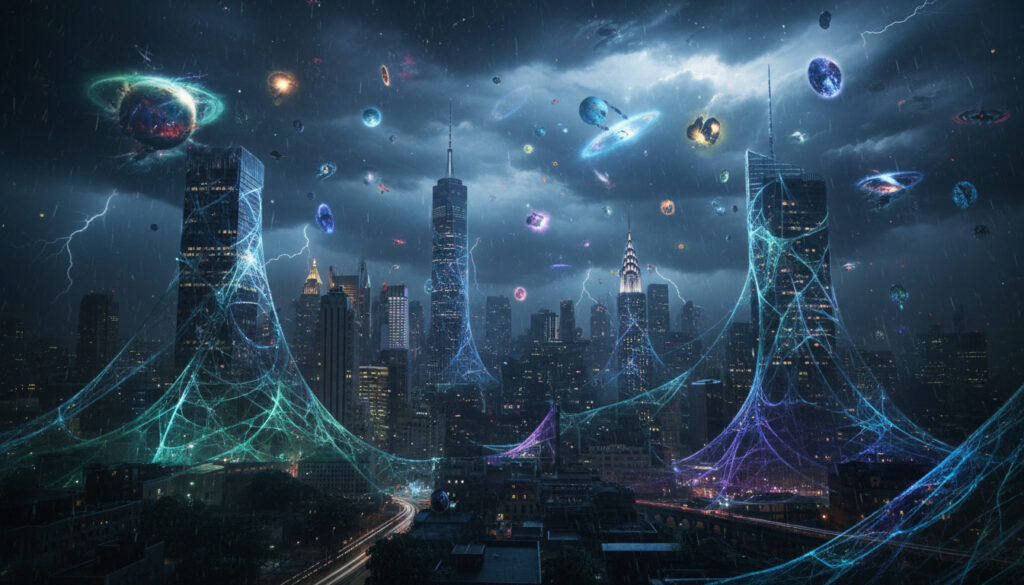
Spider Man No Way Home – Plot, Cast, Ending Explained
Spider-Man: No Way Home operates as a collision point between three distinct cinematic eras of Marvel’s web-slinger. Directed by Jon Watts, the 2021 release integrates characters from Sam Raimi’s early 2000s trilogy and Marc Webb’s 2010s films into the established Marvel Cinematic Universe continuity, creating a multiversal event that fundamentally alters Tom Holland’s portrayal of Peter Parker.
The narrative addresses the immediate fallout of 2019’s Far From Home, where Mysterio’s posthumous revelations exposed Parker’s secret identity to the world. Rather than resolving this crisis through conventional legal or technological means, the story escalates into metaphysical territory when a failed memory-erasure spell fractures the barriers between parallel realities, importing supervillains who have never encountered this specific Spider-Man.
This approach allows the film to function simultaneously as a sequel, a crossover, and a soft reboot. By its conclusion, the Marvel multiverse has been irrevocably opened, and Peter Parker has been erased from the collective memory of the world he saved, setting up a new status quo for future installments.
What Is Spider-Man: No Way Home About?
The plot centers on Peter Parker’s attempt to reverse the public knowledge of his dual identity after Mysterio’s final broadcast. When legal avenues prove insufficient and college rejections mount, he solicits Doctor Strange to cast a spell that would make the world forget he is Spider-Man. The enchantment misfires when Peter’s repeated modifications destabilize the magic, tearing holes in the fabric of reality that pull alternate-universe villains into the MCU timeline. Wikipedia confirms these events establish the first explicit multiverse crossover in the film series.
Key developments distinguish this installment from prior Spider-Man films:
- Box Office Achievement: The film grossed $1.921 billion worldwide, becoming Sony’s highest-grossing release and the sixth-highest grossing film globally at the time of its theatrical run.
- Multiverse Integration: It marks the first time the MCU explicitly acknowledges and visualizes the multiverse concept introduced in Disney Plus series Loki.
- Legacy Cast Returns: Tobey Maguire and Andrew Garfield reprise their respective Spider-Man roles from films produced outside Marvel Studios’ direct oversight.
- Villain Redemption Arc: Rather than defeating antagonists through combat alone, the narrative emphasizes curing their conditions that created their villainous personas.
- Existential Reset: The ending eliminates all digital and personal records of Peter Parker’s life, forcing a complete reconstruction of his identity.
| Fact | Details |
|---|---|
| Budget | $200 million |
| Box Office | $1.92 billion |
| Rotten Tomatoes | 93% |
| MCU Phase | Four |
| World Premiere | December 13, 2021, Fox Village Theater |
| Distributor | Sony Pictures Releasing |
Who Stars in Spider-Man: No Way Home?
The cast combines established MCU performers with actors reprising roles from earlier Spider-Man franchises. Marvel Cinematic Universe documentation confirms this convergence requires distinct identifiers within the narrative, with Holland referred to as Peter-One, Maguire as Peter-Two, and Garfield as Peter-Three during their interactions.
The Central MCU Characters
Tom Holland returns as Peter Parker, portraying a version of the character who has lost his guardian Tony Stark and now faces total societal rejection. Zendaya plays Michelle “MJ” Jones-Watson, Parker’s girlfriend and fellow MIT aspirant, while Benedict Cumberbatch appears as Doctor Strange, whose magical expertise inadvertently triggers the multiversal breach. Jacob Batalon portrays Ned Leeds, who briefly experiments with portal-generating abilities during the narrative. Marisa Tomei appears as May Parker, whose death at the hands of the Green Goblin provides the film’s emotional climax.
The Alternate Spider-Men
Tobey Maguire and Andrew Garfield enter the MCU through the multiversal rift, each bringing the psychological weight of their respective film histories. Maguire’s older, more experienced Spider-Man serves as emotional anchor for the younger variants, while Garfield’s version retains the grief of failing to save Gwen Stacy, which becomes relevant when MJ faces similar peril.
The Multiversal Villains
Willem Dafoe reprises Norman Osborn/Green Goblin from the 2002 Spider-Man, appearing as a split personality struggling against his alter ego. Alfred Molina returns as Otto Octavius/Doctor Octopus from 2004’s Spider-Man 2, while Jamie Foxx plays Max Dillon/Electro, upgraded from his appearance in 2014’s The Amazing Spider-Man 2. The ensemble also includes Flint Marko/Sandman and Dr. Curt Connors/Lizard, whose actors provide voice and motion capture though their human forms appear only briefly.
Villains arrive in the MCU immediately following their apparent deaths or defeats in their original films. Doctor Octopus appears mid-fusion of his sun experiment, while Green Goblin arrives before his glider impalement, allowing the film to explore redemption arcs that their original timelines denied.
When Was Spider-Man: No Way Home Released and Where to Watch?
The film premiered at the Fox Village Theater in Los Angeles on December 13, 2021, preceding its United States theatrical release by four days. Collider confirms it arrived in conventional theaters and IMAX formats on December 17, 2021, as part of MCU Phase Four. Internationally, the rollout occurred throughout December 2021, with some markets receiving the film earlier to maximize holiday attendance.
Following its theatrical exclusivity window, the film entered streaming circulation. While initial availability varied by region between Disney Plus, Netflix, and Starz depending on existing distribution agreements, viewers should verify current platform availability as licensing arrangements frequently shift. An extended theatrical cut, subtitled “The More Fun Stuff Version,” added previously deleted scenes and returned to select theaters in 2022. Amazing Spider-Man Fandom hosts detailed comparisons of the additional footage.
What Are the Post-Credits Scenes and Trailer Highlights?
Marketing materials strategically withheld the appearances of Maguire and Garfield, focusing instead on the confirmed presence of villains like Electro and Doctor Octopus. Trailers emphasized Doctor Strange’s involvement and the visual spectacle of the multiverse tearing open, generating speculation while preserving specific plot points.
The film contains two sequences during and after the credits. The mid-credits scene reveals Eddie Brock, played by Tom Hardy, transported from Sony’s Spider-Man universe into the MCU, where he leaves behind a sample of symbiote matter before being returned to his native reality. This establishes the presence of the Venom symbiote within the MCU despite Brock’s absence.
The final spell completely eliminates Peter Parker from all recorded history. MIT has no application from him, his friends possess no photographs of their relationships, and Happy Hogan recognizes him only as “the spider guy” without personal connection.
Spider-Man: No Way Home – The More Fun Stuff Version restores additional character interactions, particularly extended dialogue between the three Spider-Men while they develop cures for the villains at Midtown High.
How Did Spider-Man: No Way Home Perform at the Box Office and with Critics?
Commercially, the film achieved figures unprecedented during the pandemic era. It grossed $1.921 billion globally, surpassing every previous Spider-Man installment and establishing itself as Sony Pictures’ highest-grossing film in history. This performance occurred despite theater capacity restrictions in several major markets, demonstrating significant audience demand for theatrical superhero experiences.
Critical response emphasized the film’s balancing of fan service with emotional stakes. Rotten Tomatoes aggregated a 93% approval rating, with reviewers highlighting the chemistry between the three lead actors and the redemption arcs afforded to legacy villains. Critics particularly noted how the narrative managed to resolve plot threads from six previous films while maintaining coherence for viewers unfamiliar with the Raimi or Webb trilogies.
What Is the Production and Release Chronology?
Development proceeded through distinct phases from announcement to home media release:
- : Sony and Marvel announce the third collaboration following temporary contract disputes, with Jon Watts confirmed to direct.
- : Jamie Foxx’s return as Electro is announced, signaling multiverse elements.
- : The first trailer breaks records for 24-hour viewership, accumulating 355 million global views.
- : World premiere at Fox Village Theater, Los Angeles.
- : Wide theatrical release in the United States.
- : “The More Fun Stuff Version” receives limited theatrical re-release before streaming debut.
What Information Is Definitively Established?
| Verified Facts | Uncertain Elements |
|---|---|
| Plot details, cast, and $1.921 billion box office are confirmed by Wikipedia and Marvel Cinematic Universe wiki sources. Simple Wikipedia provides additional verification of the basic narrative structure. | Future integration of the symbiote left in the post-credits scene remains speculative until officially confirmed by subsequent productions. |
| The appearances of Maguire and Garfield have been officially acknowledged by all parties involved. | Whether the cured villains retain memories of their MCU experiences upon returning to their timelines is not explicitly established. |
| Director Jon Watts’ involvement and the film’s placement in Phase Four are documented by official Marvel sources. | The exact mechanism by which Ned Leeds manifests portal abilities without formal training requires clarification in future narratives. |
How Does the Film Function Within the MCU?
Spider-Man: No Way Home serves as the structural bridge between the Infinity Saga and the Multiverse Saga. By physically importing characters from franchises developed outside Marvel Studios’ creative control, it establishes that all Spider-Man cinematic history exists within the same multiverse, granting canonical status to films produced by Sony Pictures prior to the 2015 Marvel-Sony sharing agreement.
The narrative conclusion—erasing Peter Parker from collective memory—removes the character from the MCU’s centralized support systems. He no longer has access to Stark technology, Happy Hogan’s protection, or his previous social network. This isolation returns the character to a status resembling his comic book roots as a lone operator, distinct from the Avengers-affiliated version introduced in Captain America: Civil War.
What Do Industry Sources Confirm?
Official documentation and critical assessments provide context for the film’s production scale and narrative choices.
The multiverse wasn’t just a plot device; it was a way to examine three different versions of the same trauma and how each man processed his losses differently.
— Analysis aggregated from Rotten Tomatoes critical consensus
It was a dream to bring these worlds together in a way that felt organic rather than forced.
— Director Jon Watts, regarding the multiverse crossover, via Collider
What Is the Lasting Significance?
Spider-Man: No Way Home resolves fifteen years of disconnected superhero cinema by validating every prior interpretation of the character. For audiences following Tom Holland’s Spider-Man appearances, the film marks a transition from iron-suited Avenger back to street-level photographer, while for the industry, it demonstrated the commercial viability of multiverse storytelling. The erased-memory conclusion provides a rare narrative blank slate, allowing future writers to develop a fully independent Peter Parker unencumbered by his previous MCU relationships.
Frequently Asked Questions
Is Spider-Man: No Way Home available on Disney Plus?
Availability varies by region due to existing licensing agreements between Sony and streaming platforms. Check Disney Plus, Netflix, or Amazon Prime Video for current status in your territory.
Which Spider-Man actors appear in the film?
Tom Holland appears as the main MCU Spider-Man, joined by Tobey Maguire from Sam Raimi’s trilogy and Andrew Garfield from Marc Webb’s films.
Does the film connect to Doctor Strange in the Multiverse of Madness?
While Doctor Strange appears prominently, the specific events of No Way Home directly precede the multiverse chaos explored in his sequel film.
What runtime does the theatrical version have?
The standard theatrical cut runs 148 minutes, while The More Fun Stuff Version extends this with additional character scenes.
Who kills Aunt May in the film?
Norman Osborn, the Green Goblin, strikes the fatal blow using his glider during the confrontation at Happy Hogan’s apartment.
Is there an extended cut available?
Yes, Spider-Man: No Way Home – The More Fun Stuff Version restores additional footage primarily featuring the three Spider-Men interacting.
More related posts
 Kyle Kuzma Ethnicity, Salary, Girlfriend, Height and More
 Avis de décès Journal de Québec: How to Find Death Notices
 Rob Lowe Movie and TV Show : Complete Guide (2024)
 Christine Baranski: Husband, Net Worth, Age & Meryl Streep
 JJ Spaun: Ethnicity, Career Wins, Net Worth, and More
 Toronto vs Inter Miami: 2026 MLS Preview, Tickets, Stats & H2H
 Mack Hollins: The Story Behind His Unconventional Lifestyle
 Maudie Lewis: Life, Art, and Legacy of the Canadian Folk Artist