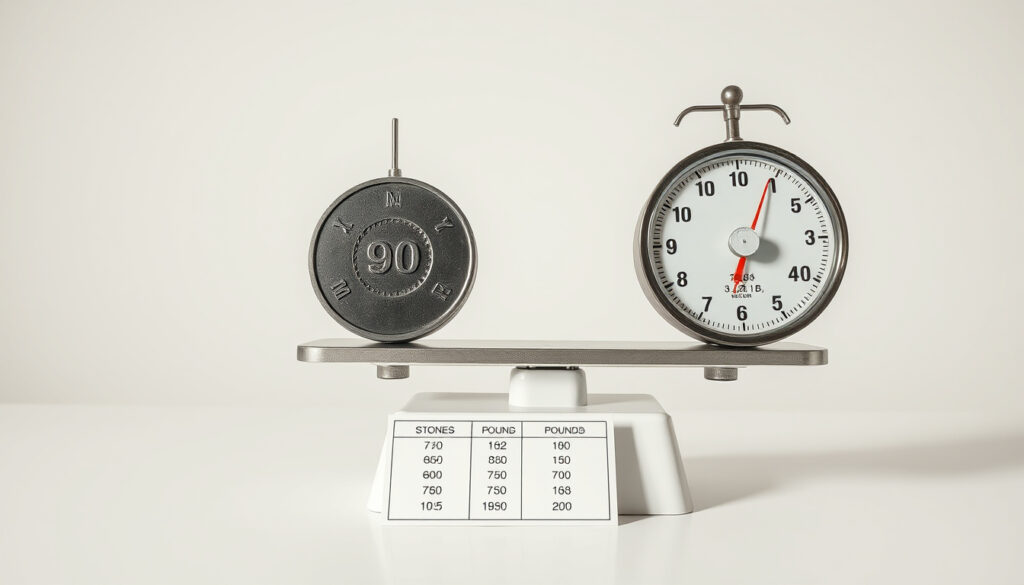
90 kg to lbs: Converter + Stones Chart (198.42 lb Exact)
If you’ve ever stepped on a scale in the UK and found yourself doing mental gymnastics, you’re not alone. Kilograms and pounds look like they should play nice, but when stones enter the picture, things get confusing fast. This guide cuts through the confusion with exact conversions for 90 kg—plus the step-by-step formula so you can convert any weight yourself.
90 kg in pounds: 198.42 lb · 90 kg in stones: 14 st 2 lb · Conversion factor: 1 kg = 2.205 lb · 90 kg in ounces: 3174.66 oz · Common chart source: NHS conversion tables
Quick snapshot
- 90 kg = 198.4 lb exactly via The Calculator Site
- 90 kg = 14.17 stones in decimal format (The Calculator Site)
- 1 kg = 2.20462 lb (international standard) (The Calculator Site)
- Whether 90 kg counts as “heavy” depends entirely on height, gender, and body composition
- BMI alone doesn’t capture fitness or health status
- NHS conversion charts remain standard references across UK clinical settings
- UHS Sussex published updated chart in March 2023
- Step-by-step conversion formula explained below
- Common tools and NHS-style reference tables included
The table below shows how 90 kilograms breaks down across all major weight units used in the UK and US.
| Unit | Value |
|---|---|
| Kilograms (kg) | 90 |
| Pounds (lb) | 198.42 |
| Stones (st) | 14.17 |
| Stones + pounds | 14 st 2 lb |
| Ounces (oz) | 3174.66 |
What is 90 kg in lbs?
The short answer: 90 kilograms equals 198.42 pounds. That’s the figure you’ll get from standard conversion tables published by The Calculator Site, which uses the internationally recognized conversion factor of 2.20462.
Conversion formula
The math is straightforward. Multiply your weight in kilograms by 2.20462 to get pounds. For 90 kg:
- 90 × 2.20462 = 198.4158 lb
- Rounded: 198.42 lb
- Approximate for quick estimates: 198 lb
The difference between the precise and approximate figure is only 0.42 lb—about 7 ounces. For most everyday purposes, 198 lb works fine.
Quick calculator use
If you need conversions regularly, bookmark an NHS-style chart like those from UHS Sussex NHS or NHS Scotland Community Pharmacy. These downloadable PDFs work offline and cover the full 60–130 kg clinical range.
90 kg × 2.20462 = 198.42 lb. Memorize the 2.2 factor for quick estimates, and use the full 2.20462 when precision matters—like medical dosing or shipping weights.
What is 90 kg in stones and lbs?
Stones are a uniquely British unit. One stone equals 14 pounds. The The Calculator Site conversion table shows 90 kg as 14 stones and 2.4 pounds.
Stones breakdown
- 90 kg ÷ 6.35029 kg/stone = 14.17 stones (decimal)
- 14 full stones + 0.17 × 14 lb = 14 st 2.4 lb
- More commonly written: 14 st 2 lb (rounded)
This mixed format—stones plus remaining pounds—is how UK NHS charts present weights clinically. Healthy Weight Grampian NHS provides downloadable conversion guides that follow this exact format.
What this means for UK patients: when your GP asks your weight, saying “14 stone 2” lands better than citing decimal stones or raw kilograms.
Full chart reference
NHS trusts across the UK maintain standardized conversion charts. NHS Greater Glasgow and Clyde last updated their chart on October 28, 2022, while Wales NHS provides a downloadable reference chart.
UK healthcare professionals use stones-and-pounds format because it matches how patients typically report their weight during consultations. Bridges the gap between metric scales and patient understanding.
Is 90 kg heavy?
This is where context becomes everything. Doctors don’t classify weights as “heavy” or “light” in isolation—they use BMI alongside height, age, gender, and build assessment.
Context for height
A BMI chart from BEST Barnsley CCG helps illustrate the problem with labels alone. At 90 kg, the “healthy” BMI range depends entirely on how tall you are:
- 5’2″ (157 cm): BMI ~36—overweight category
- 5’8″ (173 cm): BMI ~31—overweight category
- 6’0″ (183 cm): BMI ~27.6—overweight category
- 6’4″ (193 cm): BMI ~25.1—just within healthy range
The pattern is clear: a weight that signals overweight at average heights falls within healthy range only for taller individuals.
BMI considerations
BMI has known limitations. It doesn’t distinguish between muscle and fat, doesn’t account for bone density variations, and applies the same ranges across adult ages. Accurx Patient Support notes that healthcare providers use BMI as a screening tool, not a diagnosis.
For 90 kg (roughly 200 lbs), the practical takeaway: if this weight feels heavier than expected when lifting, it’s because 200 lbs sounds deceptively heavy compared to 90 kg—same number, different psychology.
BMI categories are population averages. Athletes with high muscle mass often fall into “overweight” or “obese” categories despite low body fat. Always discuss weight concerns with a healthcare provider who can assess you holistically.
Is 200 lbs 90 kg?
Yes—and this is where perception gets interesting. 90 kg and 200 lbs are numerically different, but they represent exactly the same mass.
Exact equivalence
Working backward from 200 lbs using the conversion factor: 200 lb ÷ 2.20462 = 90.72 kg. So technically, 90 kg converts to 198.42 lb, making 200 lbs about 1.6 lb heavier than 90 kg. The difference is small enough that many sources round 90 kg to “about 200 lbs” for everyday conversation.
Perception differences
Something curious happens with large round numbers. “200 pounds” sounds like a lot—especially when you’re estimating someone’s body weight. “90 kilograms” sounds lighter, maybe because 90 feels like a smaller number. Doves Farm culinary reference notes that imperial-to-metric conversions often feel psychologically heavier or lighter depending on which unit sounds “bigger.”
The implication: if you’re comparing your weight to someone else’s, make sure you’re comparing the same units—otherwise you’re measuring perception, not mass. If you’re looking for more information on this topic, you can find details on berberina per la pèrdua de pes.
How to convert kg to lbs and stones?
Whether you’re converting food weights in the kitchen or patient weights in a clinical setting, the process follows the same logic: identify your starting unit, apply the correct factor, round to practical precision.
Step-by-step process
- Start with kilograms — your known quantity (e.g., 90 kg)
- For pounds: Multiply by 2.20462 → 90 × 2.20462 = 198.42 lb
- For stones: Divide by 6.35029 → 90 ÷ 6.35029 = 14.17 st
- For mixed stones + pounds: Take the integer stones (14), multiply remainder by 14 → 0.17 × 14 = 2.4 lb
- Result: 14 st 2.4 lb, commonly written as 14 st 2 lb
The process becomes automatic once you memorize the two key factors: 2.20462 for pounds, 6.35029 for stones.
Common tools
Online calculators work for quick lookups, but NHS-style PDF charts are more practical for clinical or kitchen use. NHS Scotland Community Pharmacy downloadable Excel sheets complement their PDFs. Scottish Acute Pharmacy Group provides pharmacy-specific conversion tables.
Online calculators offer instant precision but require an internet connection. Printed NHS charts work offline but need updating when standards change. For most users, bookmarking one reliable calculator and keeping a printed chart nearby covers both bases.
Confirmed facts
- 90 kg = 198.416 lb exact via standard conversion factor
- 90 kg = 14.17 stones in decimal format
- 90 kg = 14 st 2.4 lb in mixed imperial format
- NHS charts use consistent conversion standards across UK trusts
- 1 pound = 16 ounces (standard imperial definition)
What’s uncertain
- Whether 90 kg qualifies as “heavy” depends on individual factors BMI can’t capture alone
- Optimal health weight varies too much between individuals to label a single number universally
The formulas below let you replicate any conversion from kilograms, whether you’re working with 90 kg or any other weight in the clinical range.
| Unit | Formula | 90 kg result |
|---|---|---|
| Pounds (lb) | kg × 2.20462 | 198.42 lb |
| Stones (st) | kg ÷ 6.35029 | 14.17 st |
| Stones + pounds | 14 st + (0.17 × 14) lb | 14 st 2 lb |
| Ounces (oz) | lb × 16 | 3174.66 oz |
| Grams (g) | kg × 1000 | 90,000 g |
In the Neonatal units, we measure a baby’s weight in grams. Use the table below to convert your baby’s weight to pounds and ounces.
Use this table as a guideline when converting imperial to metric measurements. You can also download and print the table by clicking the link below to have in the kitchen for future use!
The implications of imprecise weight conversion extend beyond casual confusion. In clinical settings, HCA HealthONE pediatric safety resources emphasizes that conversion charts are used for patient safety—particularly in pediatric care where dosage calculations depend on accurate weight measurements.
What this means for anyone tracking their weight: consistency in units matters more than chasing perfect precision. If you weigh yourself in kilograms one day and pounds the next, expect normal fluctuation from water retention, clothing, and scale calibration—not actual mass changes. The 90 kg figure remains stable; the number you see fluctuates.
Related reading: 52 Inches in Feet · Conversion Pouce En Cm
When delving into 90 kg as 198.42 lbs or 14 stone 2 lbs, the kg to stone and lbs converter provides complementary NHS charts for quick cross-references.
Frequently asked questions
Is 1 kg equal to 1 lb?
No. 1 kilogram equals 2.20462 pounds. A kilogram is more than twice as heavy as a pound. This is why 90 kg sounds lighter than 200 lbs even though they’re nearly identical in actual mass.
What weight is 11 stone in kg?
11 stone equals approximately 69.85 kg (11 × 6.35029). Stones and pounds convert differently than pure pounds, so always use the stone-specific divisor rather than converting through pounds first.
Is 80kg heavy for a woman?
Whether 80 kg is “heavy” depends entirely on height. At 5’4″ (163 cm), 80 kg gives a BMI of about 30. At 5’10” (178 cm), it drops to around 25.6. Context and individual factors matter far more than the number itself.
Is 200 overweight for 5’8″?
At 5’8″ (173 cm), 200 lbs gives a BMI of approximately 30.4—which falls in the “overweight” category. However, BMI doesn’t account for muscle mass, frame size, or overall fitness. A healthcare provider should assess beyond BMI alone.
What is 0.90 kg to lbs?
0.90 kg equals 1.98 lb (about 2 pounds). This is useful for cooking conversions or understanding small package weights when switching between metric and imperial systems.
How accurate are online kg to lbs converters?
Most online converters use the internationally standardized factor of 2.20462, producing accurate results to two decimal places. Variations occur only if a calculator uses a rounded factor (like 2.2 instead of 2.20462), introducing small errors of less than 1%.
Why use stones for weight in UK?
Stones remain standard in the UK because the unit has deep historical roots and patients are familiar with it. NHS conversion charts continue using stones-and-pounds format because it bridges metric scales and patient-reported weights during consultations.
More related posts
 Will Trent Season 3: Release Date, Cast, Episodes & Where to Watch
 Fun Games to Play with Friends: No Prep Ideas Indoors & Out
 Brady Martin: Latest News, Stats, and Where He’s Playing Now
 Victoria Mboko: Age, Parents, Ethnicity, and Osaka Controversy
 T20 World Cup 2026 Schedule: Match Dates, Teams & Venues
 Christine Baranski: Husband, Net Worth, Age & Meryl Streep
 Sam Elliott: Biography, Career, and Personal Life
 Chrystia Freeland Resignation: Why She Quit & What It Means