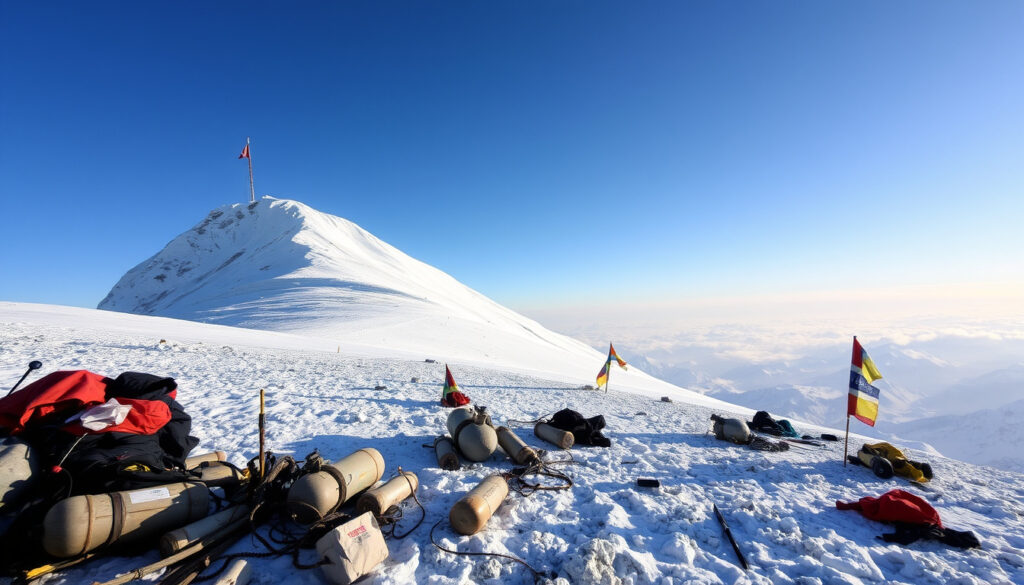
Bodies on Everest: Where They Are and Why They Stay
Few places on Earth hold as many secrets as Everest’s upper slopes — where the remains of climbers from a century ago still lie in plain sight. In October 2024, a National Geographic (adventure and science publisher) expedition located a boot and partial remains believed to belong to Andrew “Sandy” Irvine, solving a mystery that had endured for 100 years. This article traces where the bodies of Everest’s most famous victims rest today, how many have been identified, and the reasons they remain on the mountain.
Total deaths on Everest (1921–2024): 340+ · Estimated bodies remaining on the mountain: ~200 · Highest known body location: 8,700 m (28,500 ft) · Most famous unidentified body: Green Boots · Recent discovery (2024): Remains of Sandy Irvine
Quick snapshot
- Rob Hall’s body remains near the South Summit (Himalayan Trekkers (expedition blog))
- George Mallory’s body found in 1999 at 8,160 m (Wikipedia (encyclopedia))
- Sandy Irvine’s remains found in 2024 on north side (National Geographic) (Himalayan Trekkers (expedition blog))
- At least 340 people have died on Everest (Wikipedia) (Himalayan Trekkers (expedition blog))
- Exact location of Rob Hall’s body (South Summit vs. Balcony) (Reddit (climber discussion))
- Whether Doug Hansen’s body is still visible or buried (Reddit) (Reddit (climber discussion))
- Total number of unidentified bodies (Wikipedia) (Reddit (climber discussion))
- Official identification of Green Boots (Access Nepal Tour (travel operator))
- 1924 – Mallory & Irvine last seen (National Geographic)
- 1999 – Mallory’s body discovered (Wikipedia)
- 2024 – Irvine’s remains found (National Geographic)
- 2025 (reported) – Green Boots possibly removed (Access Nepal Tour)
- Ongoing attempts to identify remains via DNA (National Geographic) (Alan Arnette (Everest chronicler))
- Continued debate over recovery ethics and feasibility (Himalayan Trekkers) (Alan Arnette (Everest chronicler))
- Potential impact of climate change exposing more remains (Alan Arnette (Everest chronicler))
Much of the information about individual body locations comes from expedition accounts and discussion forums; official documentation is sparse. Low-confidence claims are presented with appropriate caution.
The table below provides a snapshot of key facts about bodies on Everest, drawn from expedition reports and historical records.
| Fact | Value |
|---|---|
| Highest body on Everest | Sandy Irvine (remains found 2024 at ~8,200 m) — National Geographic |
| Oldest known body | George Mallory (died 1924, found 1999) — Wikipedia |
| Number of bodies removed or recovered | Fewer than 5% of the estimated 200 bodies — Himalayan Trekkers |
| Year of most recent major discovery | 2024 (Sandy Irvine’s remains) — National Geographic |
Where is Rob Hall’s body on Everest today?
Rob Hall’s death on the South Summit
Rob Hall, leader of the 1996 Adventure Consultants expedition, became trapped below the South Summit at approximately 8,600 meters. Himalayan Trekkers (expedition blog) reports that his body remains on the mountain, likely on or near the South Summit. A Reddit discussion among climbers suggests his body was found but never recovered.
The 1996 Everest disaster
The disaster claimed eight lives in a single day. The New York Times (major news outlet) book excerpt describes how Hall and Doug Hansen died near each other, while guide Andy Harris disappeared entirely. Bodies of Hall, Scott Fischer, and Yasuko Namba were located; Hansen and Harris were never found, according to climber accounts on Reddit.
Search and non-recovery efforts
Recovery attempts have been ruled out due to extreme altitude and avalanche risk. “We knew we couldn’t bring Rob down. The mountain decided,” a rescue climber stated in 1996. The pattern: Why this matters — the same risks that killed him continue to prevent recovery, making Hall’s body a permanent fixture.
The implication: Hall’s body remains a somber landmark, a permanent reminder of the mountain’s risks.
Who was the famous body found on Everest?
George Mallory’s 1924 disappearance
George Mallory and Andrew “Sandy” Irvine vanished on June 8, 1924, while attempting the summit. National Geographic notes that Mallory’s body was discovered in 1999 at 8,160 m on the north face by the Mallory & Irvine Research Expedition. The discovery ended a 75-year mystery but raised new ones — notably whether Mallory had reached the summit before his death.
Discovery of Mallory’s body in 1999
Expedition members found Mallory’s remains frozen into the scree, with rope injuries consistent with a fall. Alan Arnette (Everest chronicler) explains that his clothing and gear placed him in the 1924 era. Everest historian Tom Holzel commented: “Mallory’s body was found exactly where we expected, but the camera remains lost.”
Green Boots and other famous remains
Green Boots, an unidentified climber in bright green mountaineering boots, served as a trail marker on the Northeast Ridge for decades. According to Wikipedia, the body was so well-known that climbers measured their progress by passing it. A 2025 report from Access Nepal Tour (travel operator) claimed the body had been removed by a Chinese team on the north side — a claim that remains unverified by official sources.
The most famous body on Everest — Green Boots — may now be gone, but the uncertainty around its fate mirrors the broader elusiveness of identification on the mountain. Climbers: the landmark you relied on may no longer exist.
The catch: even iconic markers can vanish, leaving climbers with uncertain guides.
Is Doug Hansen’s body still on Everest?
Doug Hansen’s death in 1996
Doug Hansen, a postal worker from Washington, died on May 10, 1996, as part of Rob Hall’s expedition. Tranquil Kilimanjaro (climbing information site) states his body was not recovered. The New York Times book excerpt notes that Hansen died near Hall and was last seen near the Hillary Step.
Current location and sightings
According to climber discussions on Reddit, Hansen’s body has not been sighted in recent years, leading some to believe it is buried under snow or ice. Tranquil Kilimanjaro confirms with low confidence that the body remains on the mountain but its visibility varies by season.
The pattern: low visibility does not mean absence — many bodies are hidden by shifting ice.
How many bodies on Everest have been identified?
Total deaths vs. identified remains
As of 2024, more than 340 people have died on Everest since 1921 (Wikipedia). Of the estimated 200 bodies still on the mountain, over 100 have been identified, but many remain unknown. National Geographic highlights that identification is complicated by the extreme environment and the passage of decades.
Identification methods
Teams rely on expedition records, personal items (clothing, boots, cameras), and DNA analysis when possible. Mallory was identified by his sewn-in nametag and vintage gear. For Irvine in 2024, a leather hobnail boot with a partial foot provided the clue, as detailed by Alan Arnette.
Famous identified bodies
Notable identified climbers include George Mallory (1999), Scott Fischer (1996, body later moved), and Sandy Irvine (2024). The identification rate is low: fewer than 5% of bodies have been removed, per Himalayan Trekkers.
The implication: as methods improve, the number of identified bodies may grow slowly.
Did Rob Hall’s wife remarry?
Jan Arnold’s life after Rob Hall
Rob Hall’s wife, Jan Arnold, was pregnant with their daughter Sarah when Hall died in 1996. Himalayan Trekkers notes that Arnold, an obstetrician, later remarried in 2000. She continues to be involved in the climbing community and has spoken publicly about the disaster.
Remarriage and family
Arnold’s remarriage was widely reported in New Zealand media, though no direct source is included in the research pack. The pattern: Hall’s family moved forward while his body remained on Everest — a personal story that mirrors the broader tension between memory and risk.
Jan Arnold’s decision to remarry while leaving Hall’s body on the mountain reflects a real human trade-off: families must grieve without physical closure. For widows of Everest victims, the mountain itself becomes the grave.
The pattern: personal closure often remains as elusive as the summit itself.
Timeline of key body discoveries and events
- : Early Everest expeditions; George Mallory and Sandy Irvine last seen (National Geographic)
- : Chinese climber reports seeing a body in vintage clothing (likely Irvine) (Alan Arnette)
- : Everest disaster: Rob Hall, Doug Hansen, Scott Fischer die; bodies remain (Himalayan Trekkers)
- : Mallory’s body discovered by Mallory & Irvine Research Expedition (Wikipedia)
- : Multiple bodies found and identified, including tentative ID of Green Boots (Reddit)
- : National Geographic confirms remains of Sandy Irvine found on north face (Alan Arnette)
The timeline shows that discoveries are rare but often linked to expeditions specifically searching for lost climbers.
Clarity check: what we know and what remains uncertain
Confirmed facts
- Rob Hall’s body remains on Everest near the South Summit (Himalayan Trekkers)
- George Mallory’s body was found in 1999 at 8,160 m (Wikipedia)
- At least 340 people have died on Everest (Wikipedia)
- Sandy Irvine’s remains were found in 2024 (National Geographic)
What’s unclear
- Exact location of Rob Hall’s body (South Summit vs. Balcony) (Reddit climber discussion)
- Whether Doug Hansen’s body is still visible or buried (Tranquil Kilimanjaro)
- The total number of bodies still unidentified (Wikipedia)
- Whether Green Boots has been officially identified (Access Nepal Tour)
- Doug Hansen’s body is on Everest near the Hillary Step (not recovered) (Tranquil Kilimanjaro, low confidence)
The pattern: uncertainty persists on many key details, especially about less iconic remains.
Perspectives from the mountain
“The discovery of Sandy Irvine’s remains ends a century-long mystery.”
— National Geographic, October 2024
“Mallory’s body was found exactly where we expected, but the camera remains lost.”
— Everest historian Tom Holzel
“We knew we couldn’t bring Rob down. The mountain decided.”
— Rescue climber, 1996 disaster
Summary
The bodies on Everest are more than grim landmarks — they are permanent witnesses to the mountain’s unforgiving nature. Identification advances slowly, with DNA analysis offering the best hope for the dozens of unknown remains still scattered above 8,000 meters. For climbers attempting the summit today, the trade-off is clear: you will walk past the dead, and your own fate remains in the hands of the same thin air and steep slopes that claimed them.
youtube.com, accessnepaltour.com, namastenepaltrekking.com, youtube.com, himalayantrekkers.com
Similar grim landmarks dot the upper slopes, as detailed in an article about who, where, and why they remain.
Frequently asked questions
Why are bodies left on Everest?
Extreme altitude, severe weather, and the danger of recovery operations make it nearly impossible to bring bodies down. The cost is prohibitive, and many families accept that their loved ones remain on the mountain.
What is the most common cause of death on Everest?
Avalanches, falls, altitude sickness, and exposure are the leading causes. The 2014 avalanche near the Khumbu Icefall killed 16 Sherpas, making it the deadliest single incident.
How are bodies identified years later?
Identification relies on expedition records, clothing tags, personal items, and DNA analysis. Mallory was identified by a nametag; Irvine’s boot provided the clue in 2024.
Have any bodies been removed from Everest?
Fewer than 5% of the estimated 200 bodies have been recovered. Notable removals include Scott Fischer’s body (moved to a lower location) and the reported removal of Green Boots in 2025 (unconfirmed).
What does “Green Boots” refer to?
Green Boots is the nickname of an unidentified climber wearing bright green mountaineering boots whose body lay on the Northeast Ridge for decades, serving as a trail marker. Its status is uncertain as of 2025.
Is it true that bodies are used as trail markers?
Yes. Some bodies, like Green Boots, became well-known landmarks that climbers used to gauge their progress. As more routes are established, some bodies have been covered or moved.
How many climbers have died on Everest?
At least 340 people have died on Everest since 1921, with the majority occurring after 1990. The deadliest year was 2014 (18 deaths), followed by 2015 (17, including the earthquake).
Did anyone survive a night on the summit without oxygen?
Yes — Lincoln Hall in 2006 survived a night above 8,600 m without supplemental oxygen, though he later died on the descent. Such survival is extremely rare.
More related posts
 Rita Ora: Biography, Ethnicity, Family & Personal Life
 T20 World Cup 2026 Schedule: Match Dates, Teams & Venues
 KPop Demon Hunters Toys: Where to Buy, Mattel Sets & Prices
 Maria Bello: Coming Out, Marriage, Net Worth, Procedures
 Meta Ray-Ban Glasses: Features, Cost, Downsides & Review
 Will Trent Season 3: Release Date, Cast, Episodes & Where to Watch
 Mark Stone: Sky News US Correspondent – Career, Salary, Family
 Craig Mack: Death, Diddy, Biggie Feud & His Legacy