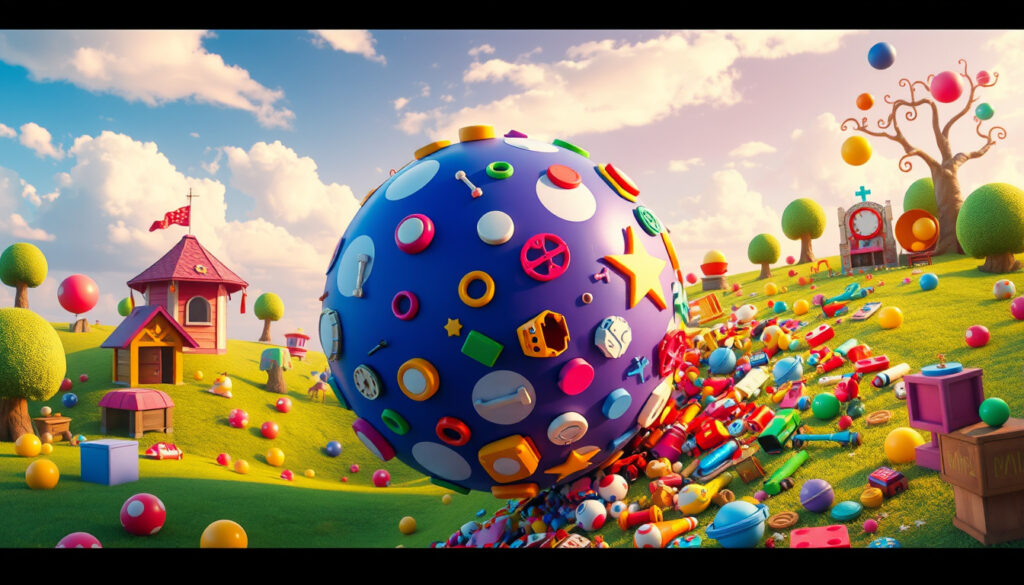
Once Upon a Katamari: New Sequel, Release Date & Price
Anyone who’s rolled a sticky ball around a surreal living room already knows the feeling: few game series are quite like Katamari Damacy. After a 14-year wait for a proper console sequel, Bandai Namco has delivered Once Upon a Katamari — a new mainline entry that brings time travel, twin-stick controls, and the same charming chaos to modern platforms, with everything confirmed from release date to price and what it means for fans.
Developer: RENGAME ·
Publisher: Bandai Namco Entertainment ·
Release Platforms: Nintendo Switch, PlayStation 5, Xbox Series X|S, Steam ·
Release Year: 2025 ·
Series: Katamari Damacy ·
Genre: Action-puzzle
Quick snapshot
- New mainline sequel, not a remake (Wikipedia entry)
- Available on Nintendo Switch, PS5, Xbox Series X|S, and Steam (Bandai Namco Europe press release)
- Story follows the Prince using a time-travel scroll after the King destroys Earth (Wikipedia synopsis)
- Exact sales figures not yet disclosed
- No future DLC or major content update announced beyond March 2026 free update
- Physical release details for some regions remain unconfirmed
- February 2025: Bandai Namco filed trademark for Once Upon a Katamari (Wikipedia)
- July 31, 2025: Officially announced at Nintendo Direct (Wikipedia)
- October 2025: Released across all platforms (Bandai Namco Europe)
- Free content update released March 4, 2026 (Bandai Namco official site)
- Additional BGM and accessory DLC available post-launch (Nintendo Store)
- Community reception and long-term performance updates pending (Bandai Namco official site)
Here are the core specifications verified from official sources.
| Attribute | Detail |
|---|---|
| Developer | RENGAME (Wikipedia) |
| Publisher | Bandai Namco Entertainment (Bandai Namco Europe) |
| Release Date | October 24, 2025 (Steam: October 23, 2025) (Bandai Namco Europe; Steam store) |
| Main Story Length | 8–10 hours |
| 100% Completion | 15–20 hours |
| ESRB Rating | E (Everyone) |
For anyone who has waited since Katamari Forever (2009) for a proper console follow-up, Once Upon a Katamari is exactly that — a full mainline sequel built by RENGAME, not a remaster or a mobile port. The wait is over, and the game is available now across every major platform.
Is Once Upon a Katamari a new game or remake?
It’s a new game — and that distinction matters for anyone wondering whether to pay full price for a 20-year-old concept. Once Upon a Katamari is not a remake or remaster of any previous title. According to Wikipedia’s entry (neutral cited overview), it is classified as a mainline sequel in the Katamari Damacy series, developed by RENGAME and published by Bandai Namco Entertainment.
Distinction from remasters and remakes in the Katamari series
- Not a remaster: The game features entirely rebuilt assets, new level designs, and a new story — none of the recycled geometry or texture packs that define a remaster.
- Not a remake: It does not re-create a single previous game’s campaign. Instead, it introduces a time-travel narrative where the Prince must collect objects across past and present to restore the cosmos.
- Developer change: Earlier ports like Katamari Damacy REROLL (2018) were outsourced remasters of the original PlayStation 2 game. Once Upon a Katamari is built from the ground up by RENGAME, a different studio than the original Nintendo/NAMCO teams.
How Once Upon a Katamari fits as a mainline entry
The series has seven canonical console releases. Once Upon a Katamari is the eighth, and the first original console installment since Touch My Katamari (2011) — a 14-year gap. The Bandai Namco Europe press release (official publisher description) describes the story as: “The King of All Cosmos was fiddling with a scroll and accidentally destroys the earth and stars.”
The implication: this isn’t a spin-off or a side experiment. It’s the real eighth entry in a much-loved series, carrying the numbered logic forward even if the title doesn’t say “4” or “5.”
Fans who skipped last decade’s mobile and handheld side entries now have a console-native sequel that respects the original formula while updating the controls to modern expectations. RENGAME’s role means the game feels fresh, not like a museum piece.
Is Once Upon a Katamari a sequel?
Yes — and the evidence goes beyond marketing tags. Once Upon a Katamari is confirmed as a mainline sequel by Wikipedia (neutral cited overview), with a narrative that directly continues the Katamari Damacy universe. The King, once again, causes cosmic destruction — this time by fiddling with a scroll — and the Prince must travel through time to fix it.
The King of All Cosmos was fiddling with a scroll and accidentally destroys the earth and stars. — Bandai Namco Europe press release
Narrative continuation: The King fiddles with a scroll and destroys Earth
- The story picks up after the events of previous games, with the King’s carelessness as the trigger.
- The Prince acquires a time-travel scroll that lets him revisit past and present settings, from feudal Japan to a glittering cityscape.
- Each era presents unique objects to collect, tying the gameplay to the narrative in a way earlier games didn’t — levels aren’t just themed; they’re historical.
Gameplay evolution: twin-stick controls and time-travel mechanics
This is the first mainline Katamari game to adopt twin-stick controls as the default scheme. Nintendo’s official store page (primary platform listing) confirms a magnet tool that lets the player attract nearby objects — a new mechanic that reduces the frustration of missing small items. IGN’s Charlie Wacholz praised it as “the best the Katamari series has been since the PlayStation 2 era.”
The best the Katamari series has been since the PlayStation 2 era. — Charlie Wacholz, IGN
The pattern: twin-stick controls solve a problem the original PS2 stick couldn’t — precise diagonal movement. On modern controllers, both sticks forward means forward; one stick at an angle means a turn. It’s a small change that makes the game feel responsive instead of floaty.
How long is Once Upon a Katamari?
Completion times fall into two clear brackets, depending on whether you’re racing through the main story or chasing every collectible. Data from HowLongToBeat (community-driven completion tracker) provides the benchmarks:
| Playstyle | Estimated Time |
|---|---|
| Main Story | 8–10 hours |
| Main Story + Extras | 12–15 hours |
| 100% Completion | 15–20 hours |
Main story completion time estimate
- Eight core levels, each requiring the Prince to roll a katamari up to a target size.
- Some levels have time limits; others are free-roll until the target is met.
- First-time players without prior Katamari experience should expect closer to 10 hours.
100% completion content including collectibles and challenges
- Collectible cousins (hidden characters) scattered across levels.
- Time-attack mode targets for each stage.
- All accessories unlocked and equipped at least once.
- Completionists will replay levels multiple times to reach the highest size thresholds.
The trade-off: Katamari games are short by design — rolling a ball bigger and bigger is a simple loop that doesn’t overstay its welcome. At 8 hours, the main story is tight; at 20 hours, the completion run is satisfying without being exhausting.
What are the platforms and price for Once Upon a Katamari?
Four platforms, one standard price, and an optional deluxe edition with soundtrack DLC. Here’s the breakdown confirmed by Bandai Namco Europe (official publisher announcement):
| Platform | Standard Edition Price | Deluxe Edition Price | Release Date |
|---|---|---|---|
| Nintendo Switch | $49.99 USD | $79.99 USD | Oct 24, 2025 |
| PlayStation 5 | $49.99 USD | $79.99 USD | Oct 24, 2025 |
| Xbox Series X|S | $49.99 USD | $79.99 USD | Oct 24, 2025 |
| Steam (PC) | $49.99 USD | $79.99 USD | Oct 23, 2025 |
Nintendo Switch 1 and 2 compatibility
The game runs on both the original Nintendo Switch and Nintendo Switch 2 via backward compatibility. Nintendo’s official store (primary first-party retailer) lists the Switch version with standard and deluxe editions, confirming digital pre-orders are live.
Standard and special edition pricing
The King of All Sounds (Deluxe) edition includes two soundtrack DLCs: Side A (26 BGMs + 18 accessories) and Side B (34 BGMs + 8 accessories). The standard edition is $49.99, positioning it below the typical $69.99 AAA price — a deliberate choice for a niche but beloved franchise. Nintendo’s store (first-party retailer) lists the BGM bundle DLC separately at $29.99 for those who buy the standard edition and want the music later.
The catch: the deluxe edition costs $30 more but includes DLC that would cost the same as the game’s base price if bought separately. For soundtrack enthusiasts, the deluxe edition is effectively a pre-paid bundle; for everyone else, the standard edition is the smarter buy.
Why did Keita Takahashi leave Namco?
Keita Takahashi, the creator of Katamari Damacy, left Namco in 2009. Wikipedia’s biography of Takahashi (cited career timeline) confirms he wanted to pursue independent creative projects rather than continue making sequels at a major publisher.
Keita Takahashi’s role in the Katamari series
- He directed the original Katamari Damacy (2004) and We ♥ Katamari (2005).
- His design philosophy — small, weird, joyful projects — defined the series’ identity.
- After his departure, the series continued under other directors (including at RENGAME).
His departure from Namco and subsequent work
- Post-Namco, Takahashi released Noby Noby Boy (2009), Tenya Wanya Teens (2014), and Wattam (2019).
- None of these reached the commercial or cultural impact of Katamari Damacy.
- His departure marks a clear before-and-after: the original trilogy (2004-2005) under Takahashi’s direction is widely considered the series’ peak, while later entries have varied in reception.
Why this matters: Takahashi’s absence from Once Upon a Katamari doesn’t make it a lesser game, but it does mean the creative DNA comes from RENGAME’s interpretation of the franchise, not the original creator. For purists, that’s a caveat; for newcomers, it may not matter at all.
Why is Katamari Damacy so good?
Twenty years after its PlayStation 2 debut, Katamari Damacy remains a touchstone for weird, joyful game design. The reasons are threefold: a core mechanic that’s ridiculously simple, an art and music direction that’s totally singular, and a critical reception that has only grown over time.
Core gameplay loop: rolling objects to grow your katamari
- Start by rolling up thumbtacks and erasers. Within minutes, you’re collecting dogs, stop signs, and entire houses.
- The physics are elastic and forgiving — objects stick if you hit them at the right angle, bounce off if you miss.
- Each level has a size target, but there’s no fail state beyond running out of time: the loop is pure, escalating satisfaction.
Art style, music, and unique atmosphere
- The visual design mixes low-poly 3D with bright, saturated colors and surreal proportions.
- The soundtrack, led by Yū Miyake, blends jazz, pop, and chiptune vocals with lyrics like “Katamari on the rocks.”
- The King of All Cosmos — a booming, self-absorbed narrator — delivers every instruction with inappropriate grandeur.
Critical consensus on timeless design
Wikipedia’s entry on the original game (neutral cited overview) notes it was praised for its originality and addictive gameplay. IGN wrote in 2004 that “it’s one of the most original games you’ll ever play.” The Once Upon a Katamari sequel received “generally favorable” reviews on Metacritic, according to Wikipedia (review aggregation summary). On Steam, user reviews sit at 91% positive from 1,269 reviews (Steam store (official PC distribution platform)).
The pattern: Katamari games succeed because they refuse to be complicated. The challenge isn’t mastering a control scheme — it’s learning to see the world as a collection of things that can be rolled up. That shift in perspective is what makes the series endure.
For players new to the series, Once Upon a Katamari is the most accessible entry point since the original. The twin-stick controls remove the clumsiness that turned away some players in earlier games. For veterans, the time-travel levels add enough novelty to justify the purchase — especially at $49.99, not the full $69.99 price of most new releases.
The pattern: the game’s design philosophy of simplicity and joy has been carried forward into Once Upon a Katamari.
Related reading: Diablo 4 Release Date: Base, Seasons, Lord of Hatred & Platforms
Frequently asked questions
Is Once Upon a Katamari a remake of an older game?
No. It is a brand-new mainline sequel, not a remake or remaster of any previous game in the series. It was developed by RENGAME and published by Bandai Namco Entertainment.
Can I play Once Upon a Katamari on Nintendo Switch 1?
Yes. The game is available on the original Nintendo Switch and is backward-compatible with Nintendo Switch 2.
Is Once Upon a Katamari a single-player game?
Yes. It is a single-player-only experience. There is no local or online co-op mode.
Does Once Upon a Katamari have a physical release?
Yes, physical editions are available in most regions for Nintendo Switch, PlayStation 5, and Xbox Series X|S. Check local retailers for availability.
What is the age rating for Once Upon a Katamari?
ESRB E (Everyone). No violence, mild cartoon mischief.
Are there multiple difficulty levels in Once Upon a Katamari?
No traditional difficulty select. Levels have size targets and optional time limits; failing only means you replay the stage. The game scales naturally as your katamari grows.
Does Once Upon a Katamari have leaderboards or online features?
No official leaderboards are confirmed. The game is entirely offline single-player. Time-attack modes track personal bests locally.
Who developed Once Upon a Katamari?
The game was developed by RENGAME and published by Bandai Namco Entertainment.
More related posts
 Ant-Man Franchise: Box Office, Age Rating, and Future
 What Is Distilled Water – Definition, Production, Uses
 Alberta Separation Referendum Question – What You Need to Know
 Lorenzo Lamas Biography, Net Worth, and Current Life
 Raghav Chadha: Age, Wife, Net Worth, Party, and More
 Justin Bieber Net Worth 2026: Inside His $200M Fortune
 RBC Line of Credit: Rates, Limits, and How It Works (2025)
 Ghislaine Maxwell 2026: Prison Status and Congressional Probe