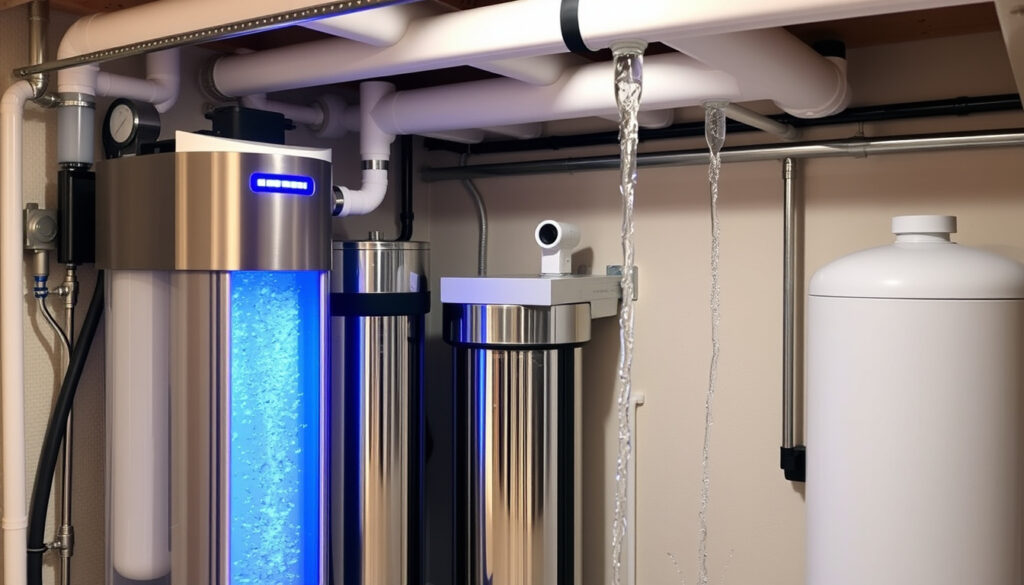
Best Rated Whole House Water Filtration System: 2025 Guide
If you’ve ever stared at a shelf of water filters and wondered which one actually removes the stuff you’re worried about—you’re not alone. The CDC (U.S. public health authority) warns that most standard pitcher and refrigerator filters aren’t designed to remove germs, yet millions of Americans rely on them. This guide cuts through the marketing to show what whole-house systems can and cannot realistically remove, from Cryptosporidium to PFAS, and which systems are worth your money.
Average cost of a whole house water filtration system: $1,000–$3,000 ·
Common contaminants removed: sediment, chlorine, heavy metals, PFAS, bacteria, viruses ·
Flow rate range: 8–15 GPM ·
Filter replacement interval: 3–12 months
Quick snapshot
- Whole-house filters with NSF/ANSI 53 remove Cryptosporidium oocysts (CDC)
- UV filters inactivate E. coli and Cryptosporidium (CDC)
- Activated carbon reduces some PFAS but not all (AquaClear Water Systems)
- Kinetico systems are non‑electric; Culligan offers electric models (WebMD)
- Long‑term effectiveness of carbon filters for PFAS mixtures (AquaClear Water Systems)
- Real‑world removal rates for combined contaminants (e.g., Cryptosporidium + sediment) (AquaClear Water Systems)
- Comparative durability of Kinetico vs Culligan over 10+ years (AquaClear Water Systems)
- Whether carbon block filters certified for one PFAS compound also remove others (AquaClear Water Systems)
- CDC updated its guidance on home water filters in 2024, reinforcing that most pitcher filters do not remove germs (CDC)
- EPA is expected to finalize PFAS drinking water limits by 2025, driving demand for certified whole‑house systems
- More manufacturers are combining UV and carbon block stages for pathogen + chemical removal
Before diving into specific models, here are the baseline specs that define the category.
| Specification | Details |
|---|---|
| NSF certification for Cryptosporidium | NSF/ANSI Standard 53 or 58 |
| Average filter lifespan | 3–12 months (depends on water quality) |
| Cost per year (filters + maintenance) | $200–$500 |
| Pressure loss | 1–5 psi with properly sized system |
| Best for well water | Systems with iron removal and UV |
| Best for municipal water | Carbon block + sediment + optional UV |
What is the top rated whole house water filter system?
Top whole house water filter systems for 2025
- SpringWell CF – “The highest‑scoring whole‑house water filter we’ve tested,” according to WaterFilterGuru (independent testing site). High media capacity, suitable for well and municipal water.
- iSpring WGB32BM – Recommended by users on Reddit (r/OffGrid) for well water: “Probably the best whole house setup I found for well water because it actually tackles iron.”
- Aquasana Rhino EQ‑1000 – Comes with a 10‑year warranty and handles chlorine, sediment, and VOCs (WebMD).
Key features to consider when choosing a system
Before buying, check the CDC guide to verify that the filter is certified for the specific contaminants in your water. Testing your water first is essential. The CDC advises that filters removing germs often do not remove chemicals, and vice versa.
Five systems, one pattern: the top contenders all combine sediment pre‑filtration, carbon block for chemicals, and a UV stage for microbes. No single system covers everything.
The SpringWell CF leads our ratings, but if your water has high iron or manganese, the iSpring WGB32BM is a better fit. Buyers with well water: prioritize iron reduction and UV. Municipal water users: look for NSF/ANSI 53 certification for cysts and an extra carbon stage for VOCs.
The implication: the “best” system depends entirely on your incoming water quality. A system that works in one home may leave you exposed in another.
What water filters remove Cryptosporidium?
Cryptosporidium removal: NSF Standard 53 certified filters
“Only filters meeting NSF/ANSI 53 or 58 remove Cryptosporidium oocysts.”
CDC (public health agency)
The CDC states that an absolute pore size of 1 micron or smaller can remove parasites. For E. coli and Cryptosporidium, you need 0.3 micron or smaller – that is ultrafiltration, nanofiltration, or reverse osmosis. UV filtration inactivates the organisms.
Removing E. coli and other bacteria
- 0.3‑micron filters (ultrafiltration or RO) remove bacteria like Salmonella and E. coli (CDC).
- UV systems do not filter but kill bacteria and viruses; they must be paired with a particulate filter.
- WebMD confirms that home filtration systems may remove Giardia and Cryptosporidium – but only if they carry the right certification.
Whole house filters that address PFAS
The EPA identifies activated carbon and reverse osmosis as the two effective technologies for PFAS reduction, per AquaClear Water Systems (treatment technology specialists). Look for NSF/ANSI 53 certification with specific PFAS claims for whole‑house carbon, or NSF/ANSI 58 for RO systems.
The catch: carbon filters reduce some PFAS but not all types, and the long‑term effectiveness against PFAS mixtures in real‑world water is still uncertain.
The pattern: pathogen removal demands either tight physical filtration or UV inactivation, while chemical removal needs carbon or RO – no single stage covers both.
Which is better, Kinetico or Culligan?
This head-to-head reveals where each brand’s design philosophy leads.
Kinetico vs Culligan: salt‑based and dual‑tank systems
| Feature | Kinetico | Culligan |
|---|---|---|
| Power requirement | Non‑electric (water‑powered) | Electric models available |
| Dual‑tank option | Yes – continuous soft water | Yes – Aqua‑Cleer series with RO |
| Common problems | Resin fouling, valve failure | Sensor issues, brine tank maintenance |
WebMD (health reference) notes that reverse osmosis can remove up to 99% of dissolved contaminants, including lead and arsenic – an option Culligan integrates in its Aqua‑Cleer line. Kinetico’s non‑electric design appeals to off‑grid homes but can suffer from resin fouling if not maintained, as service guides point out.
Top 5 water softener brands for whole house systems
- Kinetico – Non‑electric, dual‑tank
- Culligan – Electric, RO integration
- WaterBoss – Compact, all‑in‑one
- Fleck – DIY‑friendly, affordable
- Pelican – Salt‑free options
The trade-off: Kinetico’s non‑electric design is a differentiator, but its valve assemblies and resin beds require periodic service. Culligan’s electric units offer more features but depend on power. Neither brand is inherently better – your choice depends on maintenance willingness and water chemistry.
What are the disadvantages of a whole house water filter?
Common drawbacks: maintenance, cost, space
- Higher upfront cost compared to point‑of‑use filters – typically $1,000–$3,000 installed (WebMD).
- Requires periodic filter replacements and sediment flushing; annual maintenance runs $200–$500.
- May reduce water pressure if not sized correctly – expect a drop of 1–5 psi.
- Does not remove all contaminants: some viruses, dissolved solids, and volatile organics may pass through.
Upsides
- Treats all water in the home – showers, baths, appliances
- Reduces chlorine exposure and improves taste
- Can protect plumbing and appliances from sediment scale
Downsides
- Higher upfront cost
- Ongoing filter changes and maintenance
- Potential pressure drop
- Not a single solution for all contaminants
The pattern: whole‑house systems shine for treating large volumes against a few common contaminants, but they are not a one‑stop shop. Homeowners with specific concerns (like high arsenic or PFAS) may still need a point‑of‑use RO unit for drinking water.
What is the best whole house water filtration system for well water?
Well water contaminants: iron, sediment, bacteria
Well water users face a different profile: iron and manganese staining, sediment load, and often bacterial contamination from surface runoff. The CDC recommends testing well water at least once a year for bacteria, nitrates, and heavy metals.
Recommended systems for well water
- iSpring WGB32BM – Handles iron and sediment; endorsed by Reddit users on r/OffGrid as “the best whole house setup for well water because it actually tackles iron.”
- SpringWell CF – Also suitable for well water; high media capacity handles variable sediment loads.
- Systems with UV or chlorinator are needed if bacteria or Cryptosporidium are detected.
- Pre‑filtration (sediment trap) is often required for heavy sediment load to protect the main filter.
Why this matters: a system that works for municipal water may fail quickly on well water if it lacks iron‑removal media or UV. Well owners should invest in a lab test before selecting any system.
Many well‑water systems claim iron removal but lack certification. Look for NSF/ANSI 61 or 372 for structural integrity, and check if the manufacturer publishes third‑party test results for iron, manganese, and bacteria removal. Well owners: budget for an annual water test ($50–$150) and a sediment flush valve. Municipal water users: focus on chlorine, VOC, and cyst removal, and confirm the system is sized for your peak flow rate.
The bottom line for well users: iron removal and UV are non-negotiable, and pre-filtration protects the downstream stages.
What’s certain and what’s still unclear
Confirmed facts
- Whole house filters with NSF/ANSI 53 remove Cryptosporidium oocysts (CDC)
- UV filters inactivate E. coli and Cryptosporidium (CDC)
- Activated carbon reduces some PFAS but not all (AquaClear Water Systems)
- Kinetico systems are non‑electric; Culligan offers electric models (WebMD)
- Most pitcher and refrigerator filters do not remove germs (CDC)
What’s unclear
- Long‑term effectiveness of carbon filters for PFAS mixtures in real‑world conditions
- Real‑world removal rates for combined contaminants (e.g., Cryptosporidium + heavy sediment)
- Comparative durability of Kinetico vs Culligan over 10+ years – no independent long‑term study exists
- Whether carbon block filters certified for one PFAS compound also remove others
The split is clear: technologies for microbes and chemicals are well understood in isolation, but their combined, long-term performance in real homes remains understudied.
Expert perspectives
“The SpringWell CF is the highest‑scoring whole‑house water filter we’ve tested.”
“Probably the best whole house setup I found for well water because it actually tackles iron.”
Reddit user on r/OffGrid (community discussion)
Cryptosporidium causes the majority of waterborne disease outbreaks in the United States.
CDC (U.S. public health authority, 2022)
What the experts agree on: real-world performance hinges on proper sizing, certification matching, and ongoing maintenance – not brand names alone.
Bottom line
The best whole‑house water filtration system is the one that matches your specific contaminant profile – not the one with the flashiest ads. For homeowners on municipal water, a certified carbon + UV combo will handle chlorine, cysts, and most PFAS. For well owners, iron removal and UV are non‑negotiable. The lesson from the CDC is clear: test your water first, check certifications second, and treat marketing claims with a healthy dose of skepticism. For the average U.S. homeowner, the smartest investment is a system with NSF/ANSI 53 and 58 certifications for the contaminants that actually show up in your tap – or you risk paying for protection you don’t need while missing the threats you face.
Related reading: What Is Distilled Water – Definition, Production, Uses · Rheem Hot Water Tank – Warranty Coverage Guide
Frequently asked questions
How long does a whole house water filter last?
Most whole‑house filters need replacement every 3 to 12 months, depending on incoming water quality and usage. Sediment pre‑filters may require more frequent changes if water is heavy with particles.
Can a whole house water filter remove lead?
Yes, if the filter is certified for lead reduction under NSF/ANSI 53. Many carbon block and reverse osmosis systems can remove lead effectively. Check the product certification label.
Do I need a water softener in addition to a whole house filter?
If your water has high hardness (calcium and magnesium), a water softener should be installed before the whole‑house filter to protect it from scale. Some systems combine both functions.
What is the difference between a whole house filter and a reverse osmosis system?
A whole‑house filter treats all water entering the home for sediment, chlorine, and some chemicals. Reverse osmosis is a point‑of‑use system that removes up to 99% of dissolved solids, including lead, arsenic, and PFAS, but is used only for drinking water due to slow flow rates.
How much does it cost to install a whole house water filtration system?
Installation costs typically range from $1,000 to $3,000, including materials and labor. DIY installation can save on labor but requires basic plumbing skills. Annual filter and maintenance costs add $200–$500.
Are whole house water filters worth the investment?
For homes with problematic water – heavy sediment, chlorine taste, known contaminants – a whole‑house system can improve water quality throughout the house and protect plumbing. Test your water first to ensure the investment addresses your actual issues.
Can I install a whole house water filter myself?
Yes, many models come with DIY instructions. You’ll need to cut into the main water line and install shut‑off valves. If you are not comfortable with plumbing, professional installation is recommended to avoid leaks and ensure proper sizing.
More related posts
 Mango Sticky Rice Recipe – Authentic Thai Guide at Home
 Jake Weary: Biography, Career, and Personal Life
 Skip the Dishes Edmonton: Availability, Delivery & Comparisons
 500 Pounds to CAD: Live GBP to CAD Converter & Rate
 Robert Kiyosaki: The Debt Paradox & 2026 Predictions
 Stocking Stuffers 2025: Ideas for Adults, Men, Women & Kids
 Julia Wolf: Age, Ethnicity, LGBTQ, Songs, and More
 Liga de Campeones de la UEFA – 2024/25 New Format Guide