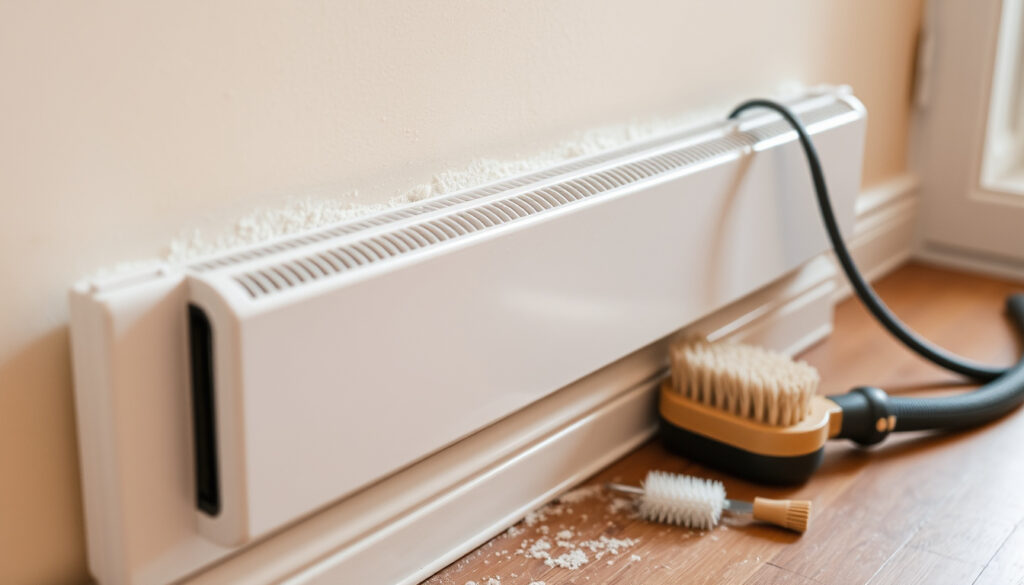
How to Clean Baseboard Heaters: Best Methods, Frequency & Tips
There’s a reason your baseboard heaters look dusty even after a quick wipe-down — dust loves the fins. A thorough cleaning once a year can improve heating efficiency by as much as 10%, according to home improvement resource eLocal. You’ll get a safe, step-by-step method using tools you already own, plus tips to avoid damaging the fins and making the problem worse.
Recommended cleaning frequency: At least once per year, before heating season · Average time per unit: 30-60 minutes · Common dust source: Carpet fibers, pet dander, and general household dust · Allergy trigger: Clogged baseboard heaters can circulate dust and allergens · Key tool: Vacuum with brush attachment
- Turn off power and let heater cool
- Remove cover
- Vacuum dust and debris
- Clean fins with brush or compressed air
- Wipe surfaces with damp cloth and replace cover
Quick snapshot
- Dust buildup reduces heater efficiency (eLocal)
- Annual cleaning is recommended by manufacturers (Fire Sense / Balkene Home)
- Water can damage electric baseboard heaters (Fire Sense / Balkene Home)
- Using a fin comb helps straighten bent fins (eLocal)
- Optimal cleaning frequency for different climates
- Effectiveness of various cleaning methods for hydronic vs electric heaters
- Long-term allergy reduction from cleaning alone
- Exact efficiency gain from cleaning varies by heater type and condition
- Clean at least once a year before heating season (Family Handyman video)
- Homes with pets or smokers may need cleaning every 6 months (Fire Sense / Balkene Home)
- Visible dust accumulation indicates immediate cleaning (Family Handyman video)
- Assemble tools: vacuum, brush, fin comb, microfiber cloths (eLocal)
- Turn off power and let heater cool (eLocal)
- Remove cover and vacuum thoroughly (eLocal)
- Clean fins and reassemble (eLocal)
Below is a quick-reference table that summarizes the most important metrics about baseboard heater cleaning and safety.
| Metric | Value |
|---|---|
| Average time per heater | 30–60 minutes |
| Energy savings after cleaning | Up to 10% on heating costs (estimated) |
| Common allergen found in heaters | House dust mites, pet dander, mold spores |
| Risk of fire | Low if cleaned regularly; dust buildup can ignite in rare cases |
What is the best way to clean baseboard heaters?
Cleaning baseboard heaters comes down to a safe, methodical workflow. Here’s how to do it without damaging the fins or the electrical components.
Turning off power and removing covers
- Switch off the heater at the thermostat and at the circuit breaker for electric units. Fire Sense / Balkene Home recommends this double cutoff for safety.
- For hot-water (hydronic) heaters, turn off the heating system and let the unit cool completely, as noted by Fire Sense / Balkene Home.
- Remove the front cover by lifting it up and pulling outward. Some models may require removing end caps or screws first (home improvement resource eLocal).
Vacuuming dust and debris
- Use a vacuum with a brush attachment to remove surface dust from the fins, interior, and the floor below (eLocal).
- For stubborn dust, a soft-bristle brush or compressed air can reach crevices, but compressed air will blow dust into the room — wear a mask.
- Vacuum the cover separately with the same attachment.
Cleaning fins with a brush or compressed air
- Fins are the primary target because dust collects between them (eLocal).
- A fin comb or a soft brush can dislodge debris without bending the metal. If fins are already bent, use needle-nose pliers to straighten them carefully — the edges are sharp (eLocal).
- Compressed air can blow out loose particles from tight spaces, but it may create a mess, so do it outdoors if possible.
Wiping surfaces with a damp cloth
- After vacuuming, wipe the fins and interior with a soft, barely damp microfiber cloth (eLocal).
- For the cover, wash it with mild dish soap and warm water and dry thoroughly before reattaching (Fire Sense / Balkene Home).
- Avoid using excess water near any electrical connections.
Replacing covers carefully
- Once all parts are clean and dry, refit the cover securely. Fire Sense / Balkene Home emphasizes that covers must be properly attached to prevent fire hazards.
- Restore power and test the heater to confirm it runs normally (eLocal).
Bent fins reduce heat output by restricting airflow. Straightening them with needle-nose pliers can restore lost efficiency — a 10-minute fix that pays off in lower winter bills.
How often should you clean baseboard heaters?
General recommendation: at least once a year
- The Family Handyman video advises cleaning every year, ideally before the heating season starts.
- Annual cleaning is also the standard recommendation from most manufacturers.
Signs that cleaning is overdue
- Visible dust accumulation on fins or around the cover.
- Reduced airflow from the heater, even when the thermostat is turned up.
- Unusual odors when the heater is first turned on (dust burning off).
Factors that increase cleaning frequency
- Homes with pets (especially shedding animals) or smokers may need cleaning every 6 months.
- Heaters in high-traffic areas or near open windows collect more dust.
- If anyone in the household has allergies, more frequent cleaning can help reduce triggers.
The pattern: your cleaning schedule should reflect your home’s specific dust load. A one‑size‑fits‑all approach risks either wasted effort or reduced efficiency.
What are common baseboard cleaning mistakes?
Using too much water or liquid cleaners
- Water can damage electrical components and cause rust on fins. Fire Sense / Balkene Home warns against liquid cleaners near heating elements.
- If you must wipe surfaces, use a nearly dry cloth.
Forgetting to turn off power
- Cleaning with the power on risks electric shock. Always switch off at the circuit breaker (Fire Sense / Balkene Home).
Bending or damaging the fins
- Fins are delicate and sharp. Heavy-handed vacuuming or brushing can bend them, reducing heat transfer (eLocal).
- Always use a soft brush or fin comb, and straighten bent fins with pliers.
Skipping the deep cleaning of fins
- Surface vacuuming alone leaves dust trapped between fins. That dust acts as insulation, lowering efficiency and raising energy costs (eLocal).
Using harsh chemicals that leave residue
- Chemical residues can release harmful fumes when the heater is turned on. Stick to mild dish soap and water for covers, and dry them completely (Fire Sense / Balkene Home).
Most home cleaning guides skip the fin-combing step entirely. Skipping it means dust layers act like a blanket, forcing the heater to run longer and cost more.
The catch: even experienced homeowners often overlook the fins. A dedicated fin comb and a few extra minutes per unit is the difference between cosmetic cleaning and actual efficiency gain.
Can baseboard heat cause allergies?
How dust and allergens accumulate in baseboard heaters
- Baseboard heaters rely on convection: air passes over the heating element and rises, drawing room air through the fins. That airflow also pulls in dust, pollen, pet dander, and mold spores.
- Over months, these particles build up inside the unit.
The role of convection in spreading particles
- When the heater turns on, the convection current can blow accumulated allergens into the room. This is especially problematic for people with asthma or dust allergies (eLocal).
Steps to reduce allergy triggers through cleaning
- Regular cleaning reduces airborne allergen circulation. Use a vacuum with a HEPA filter to capture fine particles during cleaning.
- Keep the floor around the heater clean — vacuum or mop regularly to minimize dust near the intake.
A HEPA-filtered vacuum prevents dust from being re-circulated while you clean. Standard vacuums may blow fine particles back into the room, defeating the purpose.
The implication: baseboard heaters can be hidden allergy sources. Consistent cleaning with the right vacuum turns them from a problem into a solution.
What tools do I need to clean baseboard heaters?
Essential tools: vacuum, brush, fin comb
- Vacuum with brush attachment — the most effective tool for removing surface dust (eLocal).
- Fin comb — specifically designed to straighten and clean between fins without bending them.
- Soft-bristle brush — dislodges stubborn dust before vacuuming.
Optional tools: compressed air, microfiber cloths
- Compressed air — blows out dust from tight spaces but can create airborne mess; use outdoors.
- Microfiber cloths — trap dust without scratching surfaces; use slightly damp for final wipe.
- Needle-nose pliers — for straightening bent fins (eLocal).
Safety gear: gloves, dust mask
- Dust mask — essential to avoid inhaling allergens and dust particles.
- Work gloves — protect hands from sharp fin edges.
“I vacuumed the fins and was shocked at how much dust came out — it looked like a small animal. Next time I’m using a fin comb.”
— Reddit user, r/massachusetts
“We live in a 1950s home with original baseboards, and the fins are clogged solid. Tried compressed air and it helped, but the fin comb was the real game changer.”
— DIY Stack Exchange user
The implication: A fin comb is a small investment that delivers measurable efficiency gains. Skipping it is the most common reason homeowners see little improvement after cleaning.
For a thorough walkthrough, you can refer to a detailed cleaning guide that covers the complete process from start to finish.
Frequently asked questions
Can I clean baseboard heaters without removing the covers?
It’s possible to vacuum through the grille, but you won’t reach the deep dust between fins. Removing the cover is strongly recommended for a thorough clean.
Is it safe to use a leaf blower to clean baseboard heaters?
Not recommended. Leaf blowers force dust deeper into the unit and into the room, and the high pressure can bend fins. Stick to a vacuum and brush.
How do I dry baseboard heaters after wet cleaning?
Let the unit air-dry with the cover off for several hours before restoring power. Never turn on a wet heater — risk of short circuit or shock.
Should I turn off the entire circuit before cleaning?
Yes. Turning off the thermostat isn’t enough. Shut off power at the circuit breaker to eliminate any risk of electric shock (Fire Sense / Balkene Home).
Can I use a regular vacuum instead of a brush attachment?
A brush attachment improves dust pickup and protects fins. Without it, the vacuum nozzle may not reach crevices and could scratch surfaces.
What is the fastest method to clean baseboard heaters?
Vacuum with brush attachment, then use compressed air for fins, then vacuum again. Takes about 15 minutes per unit but is less thorough than using a fin comb.
Do professional baseboard cleaning services include fin cleaning?
Many do, but ask in advance. Some services only vacuum the cover and surface. A proper pro will use a fin comb and check for bent fins.
Can I use vinegar and water to clean baseboard heater covers?
Yes, a mix of equal parts white vinegar and water works well for the metal or plastic cover. Rinse and dry thoroughly to avoid rust.
A quick vacuum-only clean takes minutes but leaves dust sandwiched between fins. The full routine — fin comb, wipe, and cover wash — takes an hour per heater but can cut heating costs by up to 10% over the winter.
For homeowners who heat with baseboards, the choice is clear: invest one hour per unit each fall, or pay more all winter in lost efficiency and allergy treatments. A fin comb and a HEPA vacuum are cheap compared to the cost of needless energy waste.
Related reading: Best rated whole house water filtration system · What is distilled water
More related posts
 Dylan Strome Career: Contract, Trade, Wife & Stats
 Matt Damon: Marriage, Net Worth & Friendship with Affleck
 Perks of Being a Wallflower: Charlie’s Illness, Plot & Bans
 Bo Bichette: Ethnicity, Salary, Faith & Mets Move
 St Johns Intl Airport to Orlando – Direct Flights, Fares and Guide
 Donald Sutherland: Illness, Death, and Relationships
 Inter Miami vs New England: Latest Score, Preview & Lineups
 Joey Chestnut: Net Worth, Records, Career & 2026 Incident