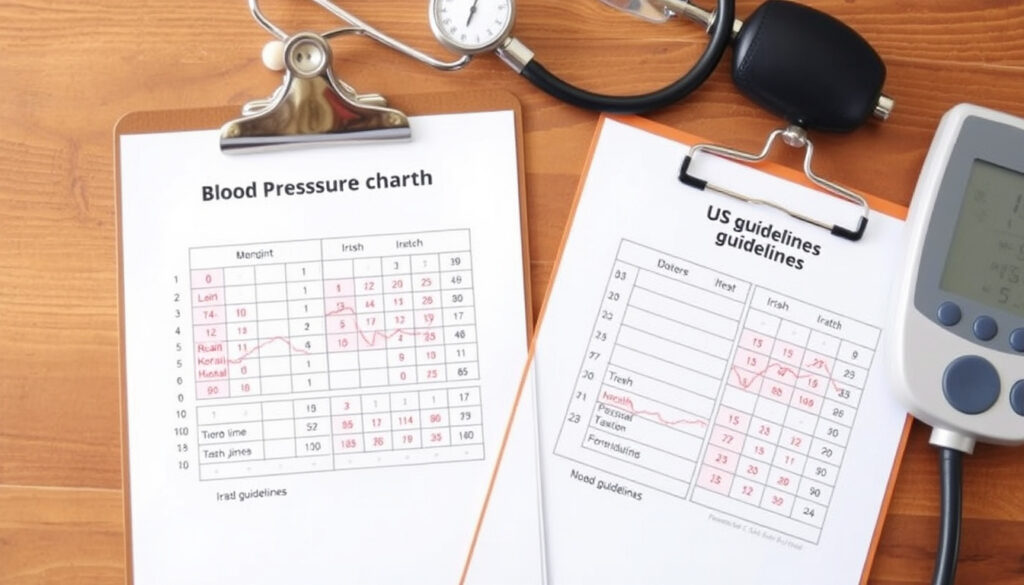
Normal Blood Pressure: Irish vs US Guidelines Explained
Most of us don’t think twice about our blood pressure until a doctor reads out a number — 120 over 80, 135 over 85, 145 over 90 — and it’s natural to wonder: is that good? In Ireland, the answer depends on which guidelines your doctor follows, because the HSE, the Irish Heart Foundation, and the European Society of Cardiology don’t all define “normal” the same way.
Normal blood pressure (US guidelines): Less than 120/80 mmHg ·
Normal blood pressure (Irish Heart): Less than 120/70 mmHg ·
Adults with high blood pressure (Ireland): 1 in 3 ·
Elevated blood pressure: 120-129 / less than 80 mmHg ·
Ideal blood pressure: Less than 120/80 mmHg (US) or 120/70 (Ireland)
Quick snapshot
- Normal BP is below 120/80 mmHg for most adults (Irish Heart Foundation)
- High BP is a major risk factor for heart disease and stroke (WHO)
- Lifestyle changes can lower blood pressure (NHS)
- ESC/ESH guidelines released 2018 for ages 16+ (Medical Independent)
- Systolic BP rises with age; diastolic BP falls after 50 (Healthspan Ireland)
- Updated Irish guidelines may align more closely with ESC/ESH (HSE)
- Home monitoring is becoming the standard for diagnosis (HSE)
Six categories, one pattern: the threshold for “normal” shifts depending on whether you’re looking at US, Irish, or European guidelines, and the gap has real consequences for who gets treated.
| Category | Blood Pressure Range |
|---|---|
| Normal (US) | <120/80 mmHg |
| Normal (Ireland) | <120/70 mmHg |
| Elevated (US) | 120-129 / <80 mmHg |
| Stage 1 Hypertension | 130-139 / 80-89 mmHg |
| Stage 2 Hypertension | ≥140 / ≥90 mmHg |
| Hypertensive Crisis | ≥180 / ≥120 mmHg |
The gap between US and Irish definitions matters: under Irish Heart standards, more adults fall into the elevated category earlier, potentially catching hypertension sooner.
What is ideal blood pressure by age?
Age is the single biggest factor in how your blood pressure behaves, but the target number stays surprisingly stable for most adults. The Irish St James’s Hospital (Dublin teaching hospital) puts the ideal at ≤120/80 for anyone aged 18 to 64. For those 65 and older, the same hospital guidance says the target relaxes to less than 140/90, with an ideal of ≤130/80.
Age shifts the target mostly for the over-65s, not because lower numbers stop being beneficial, but because the risk of falls from overtreating becomes a real concern. The HSE explicitly sets a higher threshold of 150/90 for people over 80.
What is normal blood pressure for a woman?
- Normal BP for women under 65 follows the same standard: below 120/80 mmHg (American Heart Association (AHA, cardiology authority))
- Women may experience BP changes during pregnancy, menopause, and with oral contraceptive use
- The Irish Heart Foundation (cardiac charity) defines normal as less than 120/70 for all adults, including women
The implication: sex-specific norms don’t exist in current Irish or European guidelines — the same targets apply to women and men, though hormonal factors can influence readings over a lifetime.
What is normal blood pressure for men?
- Men tend to have slightly higher BP than women until around age 60 (Healthspan Ireland (health advice platform))
- Average readings: about 115/70 in the 20s, 135/85 at age 50, 140/80 at age 60
- The target for men remains below 120/80 (US) or below 120/70 (Ireland) regardless of age up to 65
What this means: the averages drift upward as men age, but the medical target stays fixed. A 50-year-old man with 135/85 is already in the “elevated” zone and should monitor closely.
What is normal blood pressure in the morning?
- BP typically rises sharply after waking — the “morning surge” between 6 AM and noon (AHA)
- Morning readings are often the highest of the day
- Consistent measurement at the same time each day is recommended for accurate tracking
The pattern: a morning reading of 125/80 might be normal for that time of day, while the same number at bedtime could signal a problem. Timing matters.
Is 140/90 normal for blood pressure?
No — 140/90 is not normal. The American Heart Association (AHA) classifies it as Stage 2 hypertension. The Health Service Executive (HSE, Ireland’s public health authority) says high blood pressure is 140/90 mmHg or higher in a clinic setting, or an average of 135/85 mmHg at home. The Irish Heart Foundation puts the normal ceiling at 120/70, meaning 140/90 sits well above it.
The “normal” label depends on which guideline your doctor uses. Under the ESC/ESH system used widely in Ireland, 140/90 is the threshold for grade 1 hypertension. Under the stricter Irish Heart definition, you’re already two steps above normal.
Is 140 over 70 a healthy blood pressure?
- 140/70 is isolated systolic hypertension — the top number is high, the bottom number is normal
- The Irish Pharmacy Union (IPU, pharmacy professional body) notes that ESC guidelines define elevated BP starting at 120/70
- A systolic of 140 still qualifies as grade 1 hypertension even if diastolic is normal
The takeaway: 140/70 is not healthy. A high systolic reading alone increases cardiovascular risk and should be evaluated by a GP.
Should I be worried if my blood pressure is 150-70?
- 150/70 is Stage 2 hypertension under AHA guidelines and grade 1 hypertension under ESC/ESH
- The HSE says a reading of 150/90 or higher in clinic is the threshold for treatment in people over 80
- For adults under 80, 150/70 warrants medical attention and likely treatment
What this means: 150/70 is not an emergency on its own, but it is a clear signal that your blood pressure is above target and requires a management plan.
What is the danger zone for BP?
The danger zone starts where the risk of organ damage spikes. The AHA defines a hypertensive crisis as a reading of 180/120 mmHg or higher. The HSE uses the same threshold: systolic above 180 or diastolic above 120 signals an urgent need for evaluation.
What is a hypertensive crisis?
- A reading of ≥180/120 mmHg, confirmed with a second reading after 5 minutes of rest
- Can be caused by missed medication, certain drugs, or underlying conditions
- Requires immediate medical attention, especially if accompanied by symptoms
The context: a hypertensive crisis is rare but serious. It accounts for a small fraction of hypertension cases but carries the highest immediate risk of stroke or heart attack.
What blood pressure level requires emergency care?
- BP ≥180/120 with symptoms like chest pain, shortness of breath, severe headache, or vision changes — call 112 or 999
- BP ≥180/120 without symptoms still requires same-day medical evaluation (Mayo Clinic (US medical research center))
- The NHS (UK public health service) advises seeking urgent care if BP is very high and you have symptoms
The trade-off: not every high reading is a crisis, but 180/120 is the line where caution becomes action. If in doubt, measure again after 5 minutes and call your GP.
What time of day is blood pressure highest?
Blood pressure follows a predictable daily rhythm. The AHA notes that BP typically rises sharply in the early morning hours, peaking between 6 AM and noon. This is called the morning surge, and it’s a natural physiological response to waking.
How does blood pressure vary throughout the day?
- BP dips during sleep (nocturnal dipping) — a drop of 10-20% is normal
- BP rises sharply after waking (morning surge)
- Physical activity, stress, meals, and caffeine all cause temporary fluctuations
- Evening readings are typically lower than morning readings
The pattern: a single reading at 3 PM tells you less than a series of readings taken at the same time each day. The St James’s Hospital guidance recommends taking readings twice daily — once in the morning and once in the evening — for at least 7 days.
What is the morning surge?
- A natural rise in BP of 20-30 mmHg systolic upon waking
- Triggered by the body’s release of cortisol and adrenaline
- An exaggerated morning surge (≥35 mmHg) is associated with higher stroke risk
What to watch: if your morning readings are consistently 20-30 points higher than evening readings, that’s normal variation. If the gap is bigger, or if morning readings push into the danger zone, discuss it with your GP.
Can drinking lots of water lower blood pressure?
Hydration and blood pressure are connected, but not in the way many people assume. The Mayo Clinic explains that dehydration can cause blood pressure to drop (leading to dizziness) or, in some cases, rise as the body compensates. However, drinking large amounts of water does not significantly lower high blood pressure.
Dehydration can lower BP in some people, but it can also raise it in others. The body’s compensatory response to low fluid volume — constricting blood vessels — can push BP up. Drinking water at a normal, healthy level is the goal, not flooding the system.
How does hydration affect blood pressure?
- Chronic dehydration can lead to higher BP due to vasoconstriction
- Proper hydration supports normal kidney function, which helps regulate BP
- But drinking extra water beyond thirst has no proven BP-lowering effect
- The NHS recommends 6-8 glasses of fluid per day as part of general health
The implication: stay hydrated, but don’t expect water to replace medication or lifestyle changes.
What other lifestyle changes can help lower blood pressure?
- Reduce sodium intake to less than 5g of salt per day (WHO, global health authority)
- Regular physical activity — at least 150 minutes of moderate exercise per week
- Maintain a healthy weight; losing 5-10% of body weight can lower BP
- Limit alcohol to no more than 2 standard drinks per day for men, 1 for women
- The British Heart Foundation (BHF, UK cardiac charity) emphasises a diet rich in fruits, vegetables, and whole grains
What this means: lifestyle changes are the foundation of BP management. They work — often as effectively as a single medication — but they require consistency.
Key Takeaways: What We Know and What’s Unclear
Confirmed facts
- Normal blood pressure is below 120/80 mmHg for most adults (Irish Heart Foundation)
- 140/90 mmHg or higher is classified as hypertension (HSE)
- 180/120 mmHg or higher is a hypertensive crisis requiring emergency care (AHA)
What’s unclear
- The exact optimal blood pressure target for adults over 80 remains debated (HSE)
- The clinical significance of isolated diastolic hypertension in younger adults is less certain
- Whether the 2018 ESC/ESH guidelines will be updated for the Irish context
- Whether the US 120/80 or Irish 120/70 standard is more appropriate for screening asymptomatic adults remains an open question
- The extent to which lifestyle changes can normalize blood pressure varies significantly between individuals
Expert Perspectives
“Normal blood pressure is less than 120/80 mm Hg.”
“The normal level of blood pressure is less than 120 (systolic) over 70 (diastolic).”
“High blood pressure is 140/90 mmHg or higher, or an average of 135/85 mmHg at home.”
— Health Service Executive (HSE, Ireland’s public health authority)
“The latest ESC guidelines define normal BP as less than 120/70 mmHg and hypertension at 140/90 mmHg or above.”
For Irish adults, the gap between the AHA’s 120/80 and the Irish Heart Foundation’s 120/70 target is small but consequential. The difference means more people fall into the “elevated” category under Irish definitions, potentially catching hypertension earlier. For the over-65s, the HSE’s higher threshold of 150/90 reflects a pragmatic trade-off between treating high BP and avoiding overtreatment in a population more vulnerable to falls. The choice is clear: know your numbers, measure consistently, and follow the guideline that applies to your age and context.
Related reading: Lauren Ash Weight Loss: PCOS, Health, and Life Facts · Life Insurance Ireland: Types, Costs & Best Age
healthhero.ie, cwht.ie, careplus.ie, croi.ie, croi.ie, ipu.ie
For a detailed breakdown of readings across different life stages, refer to this normal blood pressure chart by age that complements the Irish and US guidelines discussed here.
Frequently asked questions
What is the difference between systolic and diastolic?
Systolic (the top number) measures pressure in your arteries when your heart beats. Diastolic (the bottom number) measures pressure between beats. Both matter, but systolic is a stronger predictor of cardiovascular risk for people over 50 (AHA).
Can high blood pressure cause headaches?
Severe hypertension (180/120 or higher) can cause headaches, but mild to moderate high BP typically has no symptoms. The NHS notes that most people with high BP feel perfectly fine, which is why it’s called the “silent killer.”
What is white coat hypertension?
White coat hypertension is when your BP is higher in a clinical setting than at home, caused by anxiety. The HSE recommends home monitoring or ambulatory BP monitoring to confirm a diagnosis.
Is low blood pressure dangerous?
Low BP (below 90/60) can cause dizziness and fainting, but it’s usually not a medical emergency unless it drops suddenly or causes symptoms. The Mayo Clinic advises seeking care if you experience severe dizziness, fainting, or shock-like symptoms.
How often should I check my blood pressure?
The St James’s Hospital guidance recommends taking readings twice daily (morning and evening) for at least 7 days if you’re being evaluated. For routine monitoring, once or twice a week is sufficient if your BP is well controlled.
Can stress raise blood pressure?
Yes — acute stress causes a temporary spike in BP. Chronic stress may contribute to sustained high BP through hormonal and behavioural pathways. The BHF recommends stress management techniques as part of a broader BP management plan.
What is the normal blood pressure for a 70-year-old?
For adults 65 and older, St James’s Hospital sets the target at less than 140/90, with an ideal of ≤130/80. For those over 80, the HSE allows a higher threshold of 150/90 in clinic.
More related posts
 Omar Sy: Ethnicity, Career, Family, and Pronunciation Guide
 Leonardo Rizzuto: Charges, Net Worth, Where He Is Now (2025 Update)
 Melanie Griffith: Biography, Movies, and Personal Life
 Sleeping Giant Provincial Park – Hiking Trails and Camping Guide
 Lorenzo Lamas Biography, Net Worth, and Current Life
 How Eileen Gu Earns $23 Million: Endorsements & More
 Ken Griffin: Net Worth, Politics, and Citadel Empire
 Avis de décès Journal de Québec: How to Find Death Notices