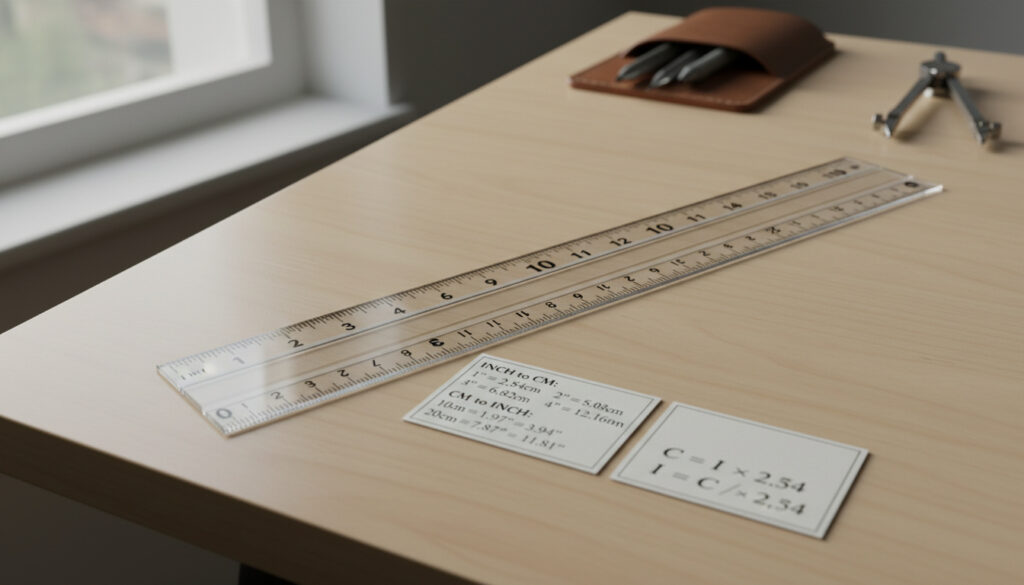
Conversion Pouce En Cm – Exact Formula, Table and Guide
Converting inches to centimeters represents one of the most common calculations bridging imperial and metric measurement systems. The conversion relies on an exact, internationally standardized factor established in 1959, eliminating approximation errors in engineering, manufacturing, and daily commerce. Understanding this precise relationship proves essential for technical specifications, international trade, and accurate dimensional analysis across diverse industries.
Global supply chains and scientific research demand unambiguous unit translation. While the United States and United Kingdom maintain customary imperial units for construction and consumer goods, the metric system dominates scientific and most international commercial contexts. The inch-to-centimeter conversion provides the critical link between these frameworks.
How to Convert Pouce (Inch) to CM
Exact international standard
Simple multiplication
US/UK to global standards
Daily applications
- Exact definition established by international treaty in 1959
- No rounding required even for precision engineering work
- Universal reference between US customary units and global metric system
- Reverse calculation: inches = centimeters ÷ 2.54
- Critical accuracy for DIY projects and technical specifications
- Maintained by NIST and BIPM standards
- Foundational for dimensional analysis in scientific research
| Inches (Pouces) | Centimeters |
|---|---|
| 1 | 2.54 |
| 2 | 5.08 |
| 5 | 12.7 |
| 10 | 25.4 |
| 12 (1 foot) | 30.48 |
| 25 | 63.5 |
| 50 | 127 |
| 100 | 254 |
Comprehensive conversion resources are available at Inch Calculator, which provides additional fractional precision values.
What is 1 Pouce in CM?
One inch equals exactly 2.54 centimeters. This value is not an approximation but a defined constant established by the international yard and pound agreement of 1959. The standardization fixed the yard at precisely 0.9144 meters, making one inch (1/12 of a yard) exactly 25.4 millimeters.
The International Standard
Scientific and trade organizations maintain this definition with absolute precision. NIST specifications confirm the inch as exactly 25.4 mm for all precision engineering applications. This definition eliminates the fractional variations that plagued historical measurement systems, ensuring that international manufacturing components interface correctly regardless of origin.
Historical Origins
Medieval England birthed the inch from anthropomorphic measures, variously defining it as the width of a man’s thumb or the length of three barleycorns placed end-to-end. These organic origins produced regional variations until the twentieth century standardization. Educational resources detail how these historical measurements gradually unified into the modern exact standard.
The International Bureau of Weights and Measures (BIPM) and the US National Institute of Standards and Technology (NIST) both specify 1 inch as exactly 25.4 millimeters. This creates an unambiguous conversion factor used universally in metrology, manufacturing, and scientific research.
Inch to CM Conversion Table
Reference tables expedite common conversion tasks. Technical documentation frequently requires rapid translation between these units, particularly in engineering environments where imperial and metric tools coexist.
Fractional Precision
Digital calculators and conversion applications handle fractional inches with exact precision. One-quarter inch translates to 0.635 centimeters, while three-eighths inch equals 0.9525 centimeters. Academic sources demonstrate these calculations for educational applications.
When converting measurements for manufacturing specifications, preserve exact values. Four significant figures in your original measurement yield precise centimeter equivalents. For example, 4.72 inches converts to exactly 11.9888 cm, maintaining precision throughout calculations.
Extended Applications
Larger measurements follow the same linear relationship. Twenty-five inches equal 63.5 centimeters, while fifty inches translate to 127 centimeters exactly. These values apply directly to screen dimensions, lumber sizing, and textile measurements.
CM to Pouce Conversion Formula
Reverse conversion requires dividing centimeters by 2.54 or multiplying by 0.393700787. This calculation proves essential when interpreting metric specifications for imperial-based manufacturing systems or comparing international product dimensions.
Reverse Calculation Method
Thirty centimeters divided by 2.54 equals approximately 11.81 inches. One hundred centimeters (one meter) converts to approximately 39.37 inches. These reverse calculations enable seamless translation between architectural drawings, automotive specifications, and consumer product dimensions.
Never approximate 2.54 as 2.5 in technical work. This 0.04 centimeter discrepancy compounds significantly across larger measurements, potentially causing critical engineering failures or component fit issues in manufactured goods.
Practical Implementation
Manufacturing specifications for Rheem Hot Water Tank Specs demonstrate how these conversions appear in product documentation. Technical manuals often list dimensions in both systems to accommodate global markets.
Evolution of Measurement Standards
-
Medieval England
The inch originated as approximately the width of three barleycorns or a man’s thumb, varying by region and application.
-
1959 International Agreement
Participating nations established the yard as exactly 0.9144 meters, thereby fixing the inch at precisely 2.54 centimeters.
-
1983 Meter Redefinition
The meter was redefined as the distance light travels in vacuum during 1/299,792,458 second, anchoring the centimeter and by extension the inch to fundamental physical constants.
Historical documentation is maintained by BIPM, the international authority on measurement standards.
Established Facts and Historical Variations
Definitive Standards
- 1 inch = 2.54 cm exactly (since 1959)
- Defined by international treaty
- Maintained by NIST and BIPM
- Universal in scientific and trade applications
Pre-Standardization Variations
- US survey inch differed slightly (approximately 0.999998 survey inch per standard inch)
- Historical UK standards varied by industry
- Based on physical artifacts subject to environmental variation
- Subject to metrological drift over centuries
Background on Inch and CM Units
The imperial system traces its lineage to medieval English customary units originally based on agricultural and human-scale references. The inch emerged from these folk measurements, gaining legal definition through English parliamentary acts before spreading globally through British colonial influence. Such organic origins produced inherent variability until twentieth-century international agreements imposed exact metric equivalences.
The metric system arose from French revolutionary efforts to rationalize measurement, establishing the meter originally as one ten-millionth of the distance from the equator to the North Pole. Modern definitions anchor the centimeter (1/100 of a meter) to the speed of light in vacuum, creating a measurement system independent of physical artifacts. Jeep Grand Cherokee L 2024 Specs illustrate how automotive engineering often navigates between these systems.
Contemporary applications range from screen technology, where diagonal measurements traditionally use inches, to scientific research requiring metric precision. Construction materials in North America typically retain imperial sizing even when exported, necessitating constant conversion.
Official Standards and Definitions
The inch is exactly 25.4 millimeters and is used in precision engineering and international trade.
— NIST Reference on Constants, Units, and Uncertainty
Standards organizations enforce these definitions to ensure compatibility across international borders. Engineering tolerances, manufacturing specifications, and scientific research all rely on this exact conversion factor.
Essential Conversion Reference
Converting between inches and centimeters requires applying the exact factor of 2.54 through simple multiplication or division. Established by international agreement in 1959 and maintained by global standards bodies, this conversion enables precise communication across measurement systems essential for modern engineering, manufacturing, and commerce.
Frequently Asked Questions
Is 1 inch exactly 2.54 cm or approximately?
It is exact. The 1959 international yard and pound agreement defined 1 inch as exactly 2.54 centimeters, with no rounding or approximation.
How do I convert inches to centimeters manually?
Multiply the inch measurement by 2.54. For example, 5 inches multiplied by 2.54 equals exactly 12.7 centimeters.
What is 12 inches in centimeters?
Twelve inches equals exactly 30.48 centimeters. This corresponds to one foot in the imperial system.
How do I convert centimeters back to inches?
Divide the centimeter value by 2.54. Alternatively, multiply by 0.393700787 to obtain the inch equivalent.
Why is the inch defined as 2.54 cm specifically?
This value derives from the 1959 definition of the yard as exactly 0.9144 meters. Since one yard equals 36 inches, each inch must equal exactly 2.54 centimeters.
Who maintains the official definition of the inch?
The National Institute of Standards and Technology (NIST) in the United States and the International Bureau of Weights and Measures (BIPM) globally maintain these definitions.
Can I use 2.5 instead of 2.54 for quick estimates?
For rough estimates only. The 0.04 cm difference creates significant errors in precise work, particularly when scaled to larger measurements or engineering tolerances.
More related posts
 Ozempic Side Effects In Females – Risks, Hair Loss, Fertility Guide
 Mac McClung: Why 3 Dunk Titles Don’t Mean NBA Minutes
 RBC Line of Credit: Rates, Limits, and How It Works (2025)
 Can Dogs Have Pineapple? Safety, Benefits and Risks
 Jonathan Bennett: Husband, Net Worth, and Career Facts
 Chloe Parker: Age, Relationship with N3on, and TikTok Fame
 Christine Baranski: Husband, Net Worth, Age & Meryl Streep